Igbo language often conceals deep metaphysical insights beneath seemingly ordinary words. One such word is Oseaka, a colloquial term that can describe a vagabond, a prodigal person, a spendthrift, a rascal, or generally a ne’er-do-well.
While it is commonly used as a social description, a deeper examination through the lens of Afa corpus reveals that Oseaka may point toward something much more significant, i.e. a manifestation of Ara Agwu, particularly when the condition expresses itself through chronic financial self-destruction and the inability to properly steward one's resources.
What is a Spendthrift?
A spendthrift is a person who spends money recklessly and extravagantly, often without consideration for future consequences. Such a person may repeatedly squander opportunities, resources, wealth, relationships, or even inherited blessings through impulsive actions and poor judgment.
The spendthrift consumes faster than they produce. They destroy faster than they build.
From a spiritual perspective, this raises an important question:
Why do some individuals repeatedly lose everything they acquire, regardless of how many opportunities they receive?
Within Igbo spiritual thought, one possible answer presents itself in understanding the relationship between Aka Ose and Ose Aka.
Aka Ose and Ose Aka
In Afa Akpukpala corpus, word order or the state in which patterns appear carries tremendous significance.
Aka Ose
Igbo expression: Akasa or Aja Ana
English expression: Akashic Records, Earth Consciousness, or Astral Light
Aka Ose can refer to what many esoteric traditions describe as the repository of lived intelligence. It is associated with Aja Ani, the consciousness of the Earth itself; the vast field in which all experiences, actions, memories, and wisdom are stored.
Within this understanding, every experience leaves an imprint. Nothing is lost. All life contributes to an ever-expanding archive of intelligence.
Aka Ose therefore symbolizes:
Grounded wisdom
Living memory
Accumulated experience
Consciousness in harmony with reality
Intelligence rooted in the Earth principle (Ani, Ala, or Ana)
It is knowledge that has become integrated, intelligence that has become stable, and awareness that remains connected to reality.
Ose Aka
Igbo expression: Onye Agwu di n’anya or Onya Ala or Onye Efio
English expression: One imbued with the Eye of Nne Agwu or One who sees spirit or Mad person (Agwu-inflicted madness) or Rascal person
If Aka Ose represents intelligence properly stored and grounded, then Ose Aka can be viewed as its inversion.
Rather than intelligence serving reality, reality becomes distorted by intelligence.
Rather than knowledge producing wisdom, knowledge becomes fragmented, excessive, overwhelming, or disconnected from practical life.
This reversal offers a fascinating insight into the traditional understanding of madness.
Madness and Intelligence
Many cultures mistakenly assume that madness is the absence of intelligence.
Traditional Igbo thought suggests a more nuanced perspective.
Madness is not necessarily a lack of perception.
Sometimes it is an excess of perception without grounding, access without integration.
It is intelligence that has lost its anchor.
This is why many spiritual traditions throughout the world have observed a mysterious relationship between extraordinary insight and psychological disturbance. The individual may perceive realities, patterns, possibilities, or dimensions that others cannot perceive, yet lack the stability required to organize those perceptions constructively.
In this sense, Ose Aka can be understood as intelligence turned against itself.
The mind becomes unconsciously flooded.
The imagination becomes untethered.
Perception becomes excessive.
Knowledge ceases to produce wisdom.
What was once Aka Ose, stored and integrated intelligence, becomes Ose Aka, scattered and distorted intelligence.
The result is disorder.
Ara Agwu and the Spirit of Financial Dissipation
One of the less discussed manifestations of Ara Agwu is its tendency to amplify destructive spending patterns.
Many people experiencing Agwu disturbances report recurring cycles that seem irrational even to themselves:
Money arrives and quickly disappears.
Opportunities emerge but are squandered.
Prosperity is repeatedly interrupted.
Debt accumulates despite periods of abundance.
Financial stability never lasts.
In such situations, the issue may be consciousness, and not economics.
The person becomes unable to hold what they receive.
Just as a cracked vessel cannot retain water, a disturbed consciousness cannot retain abundance.
This is where Oseaka becomes relevant.
The spendthrift beyond loss of money makes one lose structure, continuity, and the capacity to convert resources into lasting value.
Everything passes through their hands yet nothing remains.
The Deeper Meaning of Oseaka
Notice the symbolism.
If Aka Ose is a cosmic storehouse where experience accumulates and is preserved, Oseaka represents the opposite tendency.
Instead of storing, there is scattering.
Instead of accumulation, there is dissipation.
Instead of preservation, there is waste.
The spendthrift nature becomes a living embodiment of energetic leakage.
Money leaks. Time leaks. Relationships leak. Opportunities leak.
Knowledge leaks. Power leaks.
The individual may appear highly intelligent, highly gifted, highly creative, or highly charismatic, yet remain unable to build durable structures around their gifts.
This paradox has puzzled families for generations, the mind boggling question remains:
"How can someone so gifted and naturally intelligent remain so unstable?"
Wealth Requires Grounding
A recurring lesson within Igbo spirituality is that prosperity is demonstrated by one’s ability to retain and sustain what has been acquired.
The Earth principle represented by Ani teaches stability, structure, patience, and continuity.
Seeds are not harvested the day they are planted.
Trees do not bear fruit immediately.
Wealth itself follows the law of the Earth. It requires grounding.
One of the hidden teachings embedded within the contrast between Aka Ose and Ose Aka is that anything which does not have grounding eventually disperses.
Ideas without grounding disperse.
Power without grounding disperses.
Intelligence without grounding disperses.
Money without grounding disperses.
A person affected by severe Oseaka tendencies may continuously seek gain while unconsciously sabotaging preservation.
They know how to receive. But they do not know how to hold or retain.
From Ose Aka Back to Aka Ose
The spiritual challenge, therefore, is not to suppress intelligence but to ground it.
The journey from Ose Aka back to Aka Ose is the journey from fragmentation to coherence.
From dissipation to preservation, chaos to order, and scattered perception to embodied wisdom.
When intelligence becomes grounded in Ani, it transforms into wisdom.
When perception becomes integrated, it transforms into insight.
When resources become properly stewarded, they transform into wealth.
And when Agwu is harmonized rather than disturbed, the same force that once produced disorder can become a source of extraordinary creativity, intuition, healing, and spiritual power.
To Sum It Up
Perhaps the greatest lesson hidden within the Igbo word Oseaka is that wastefulness is sometimes a symptom of a deeper imbalance between consciousness and grounding.
The spendthrift loses money, but the real loss may be something more fundamental, the ability to contain and preserve value.
Aka Ose teaches accumulation of wisdom.
Ose Aka reveals the danger of intelligence without integration.
Between the two we can understand that the purpose of intelligence is to become sufficiently grounded to sustain whatever positive abundance reality places in our hands.






















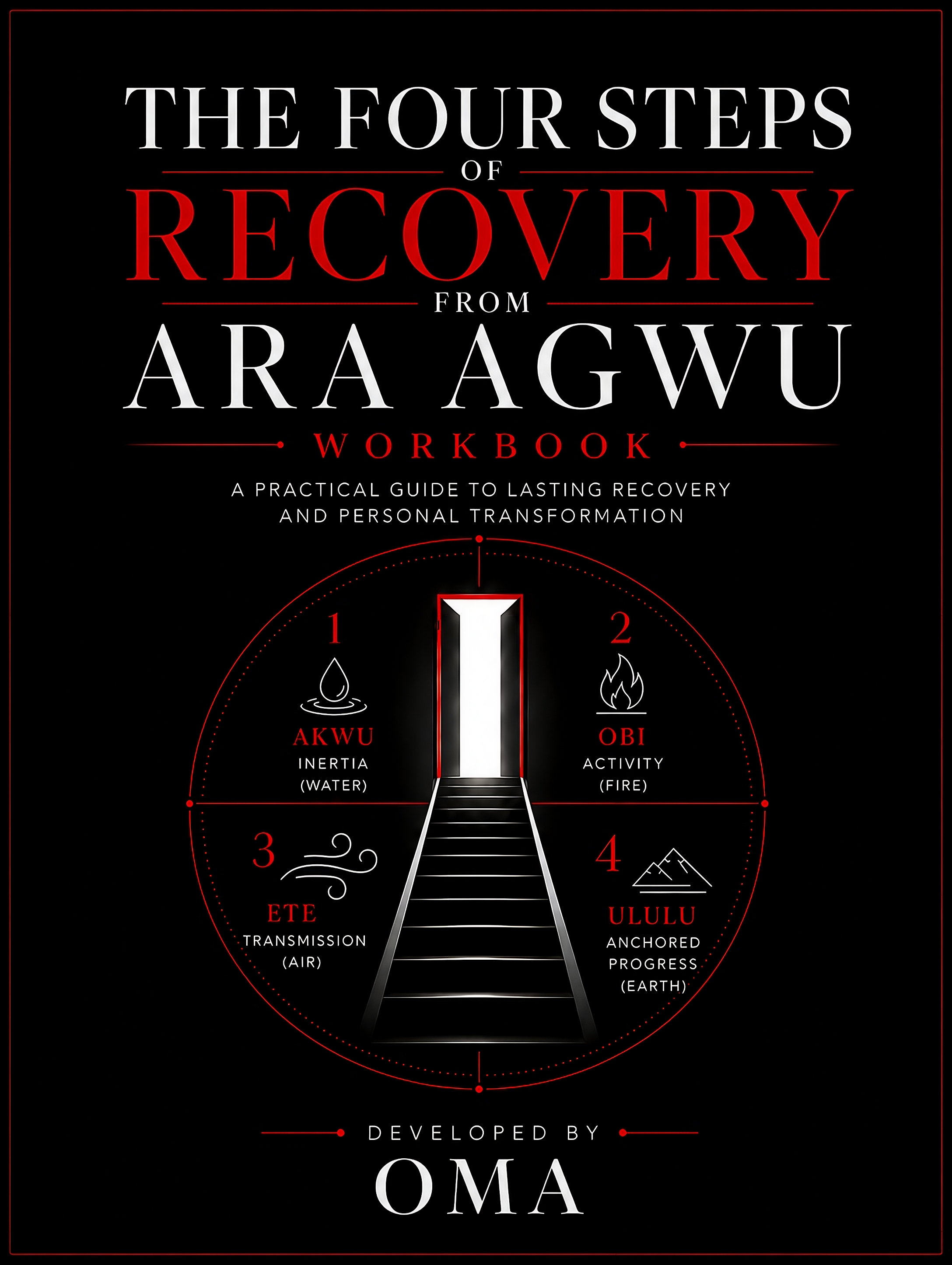
The Four Steps of Recovery From Ara Agwu (Workbook)
A practical reflection and recovery workbook designed to help seekers navigate the often complex journey of healing from Ara Agwu through a structured yet deeply personal approach.

Join Odinani Mystery School for access to Exclusive in-depth teachings on ancient Igbo wisdom and mystical sciences!