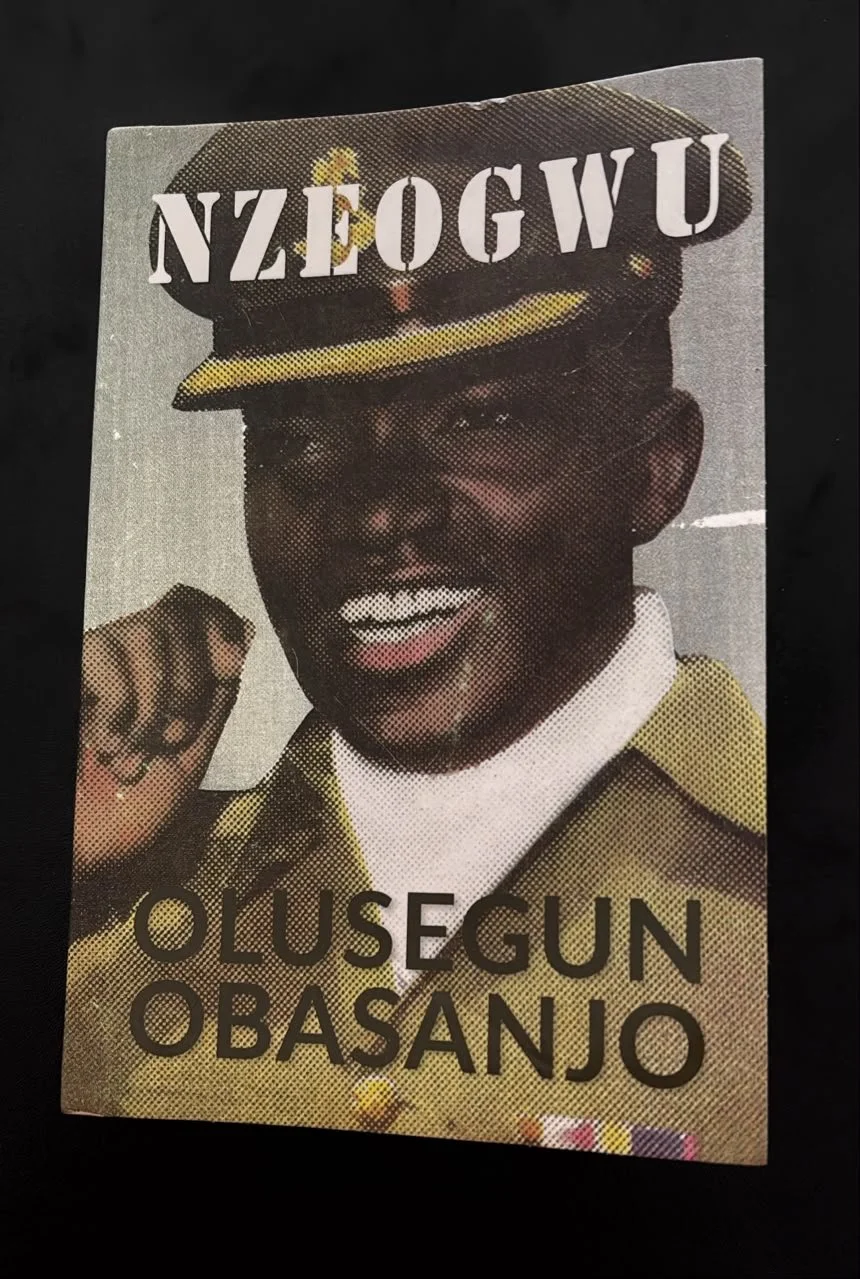
Nzeogwu by Olusegun Obasanjo
Originally published 1987
On the 26th of February 1937, an Afo market day, in the heart of Kaduna city in Northern Nigeria, a baby boy named Chukwuma Nzeogwu was born. He would later come to be known as “Kaduna,” after the city of his birth.
This child, born of a marriage that defied the customs of his people back home in Obodogwu, to a man who had once been the uncle to his now step-brother and a woman who was already the mother of his cousin, would go on to live a life that not only defied the norms of his time but also helped shape a contentious chapter of Nigerian history, one whose consequences would be felt for generations.
Chukwuma Nzeogwu would grow into a defiant young man. From his school days to his early displays of leadership, and his stubborn insistence on attending military school against his parents’ wishes, he demonstrated a strong will and an unusual determination to follow his own convictions. Yet, beyond his stubbornness, he also possessed an ability to adjust his position whenever reality presented him with a new understanding of things.
Throughout the thirty defining years of his life, with each stage of maturity, he would demonstrate a nature that was both conservative and daring. Perhaps this was partly owed to his Catholic upbringing, or perhaps to the inescapable demands of military training. Whatever the influence, at his core, Major Chukwuma Nzeogwu became a no-nonsense man, a leader willing to rebel against established authority when his convictions about the greater good demanded it.
But youth, oh yes, that youthful nature which no amount of ambition or discipline can outpace, would also hold him to a certain degree of naivety. Perhaps even inexperience, particularly in matters concerning the convictions and intentions he assumed other people shared with him.
Yet these shortcomings, which might naturally be expected of any young person, would neither stop Chukwuma Nzeogwu nor prevent him from acting on his ideals. He believed deeply in his vision of a better Nigeria and was prepared to pursue it regardless of the cost, including the taking and loss of human life.
As a military man, a product of colonial Nigeria, he had become convinced that even such a terrible price could be justified if it brought about the birth of a better nation. A Nigeria rid of corruption and the corruptible.
A gamble, some might say.
But from Major Chukwuma Nzeogwu’s point of view, it was a gamble worth taking, even if it meant removing those he considered obstacles to that dream.
However unstable the bridge between his convictions and his vision of a better Nigeria might have been, however fragile the road towards that dream appeared, it was a risk he willingly took. And when that dream collapsed into one of the most contentious chapters of Nigerian history, he accepted responsibility for his actions with the same prideful, unyielding, and unsurrendering spirit with which he had undertaken them.
The failure of his dream would lead him from the Northern city he had briefly brought under his control into the hands of authorities in the South, where imprisonment awaited him.
But one must remember that Major Chukwuma Nzeogwu remained a military man. Unless a bullet, or some other circumstance, brought the breath of life in his lungs to an end, he had to persist in that most primal act of survival. He had to hold on to the human instinct to survive, and perhaps, someday, even thrive.
He entertained the possibility of a quieter life beyond prison, perhaps establishing a hotel business of his own in Benin City. Another hopeful dream, one that would never see the light of day.
For his first love, the dream of a new Nigeria within his beloved, revived Africa, was about to take another turn.
A new direction, fed in part by seeds he and his collaborators had themselves sown, would interrupt any hope of retiring into the peaceful life of a businessman.
The day he would walk beyond the prison walls eventually came. But it came because of the very political upheaval that had followed his earlier actions. His ancestral homeland was now moving towards separation from Nigeria, the one country he had once been willing to kill and die for.
He would never truly be free of his military uniform. How could he?
He would never be free of the harvest of seeds he himself had sown, however unknowingly. Seeds of discord whose consequences had grown far beyond his original intentions.
Major Chukwuma Nzeogwu would never be set free from the destiny of his uniform.
His fate would be an early death, one brought about by the very conflict that had emerged from the collapse of his first great dream. He would find himself on the battlefield defending Nsukka, carrying out a responsibility placed upon him by a man who had so recently been his rival. It was a responsibility he could not bring himself to shy away from.
Mbèrèdé nyị̀rị̀ díké mànà mbèrèdé kà éjì àmá díké.
How could a man who had devoted his life to what he believed was the survival of the greater good reject a call to defend his own people when their survival was at stake?
And so his fate was sealed.
Major Chukwuma Nzeogwu would die at the end of his third decade on earth, fighting to defend his right to exist as a free man alongside his people.
His dreams of true freedom, his ideals of self-actualization, and whatever peaceful life he might have built for himself were all cut short.
By history, by circumstance, and ultimately, by a path of his own choosing.
Nze bu Ogwu
A chosen or initiated leader can be as potent as any mystical solution. Such is the effect of divinely appointed leadership that its outcomes can leave people wondering whether the hand of god is at work among them.
This is the meaning carried by the surname of Chukwuma Nzeogwu, a man who would go on to influence the history of Nigeria, and particularly that of the Igbo people within it, to such an extraordinary, almost mind-boggling extent.
True to the Igbo belief that one's name can greatly influence or even predict one's destiny, we might ask: Did the man fulfill his name, or did the name become the man?
And is this belief relevant only because of the particular man in question, or can its validity be equally measured against every member of his family born into the same name?
This is simply a philosophical question, rhetorical in its intention.
My point in highlighting this is to explore the notion of choice, the struggle between fate and faith. How much of one's life is predetermined, and how much is simply a matter of choice, of choosing who to become?
We beg the question, and the question begs us in return.
Who are you born to be, and who will you become?
The Speech That Changed Everything
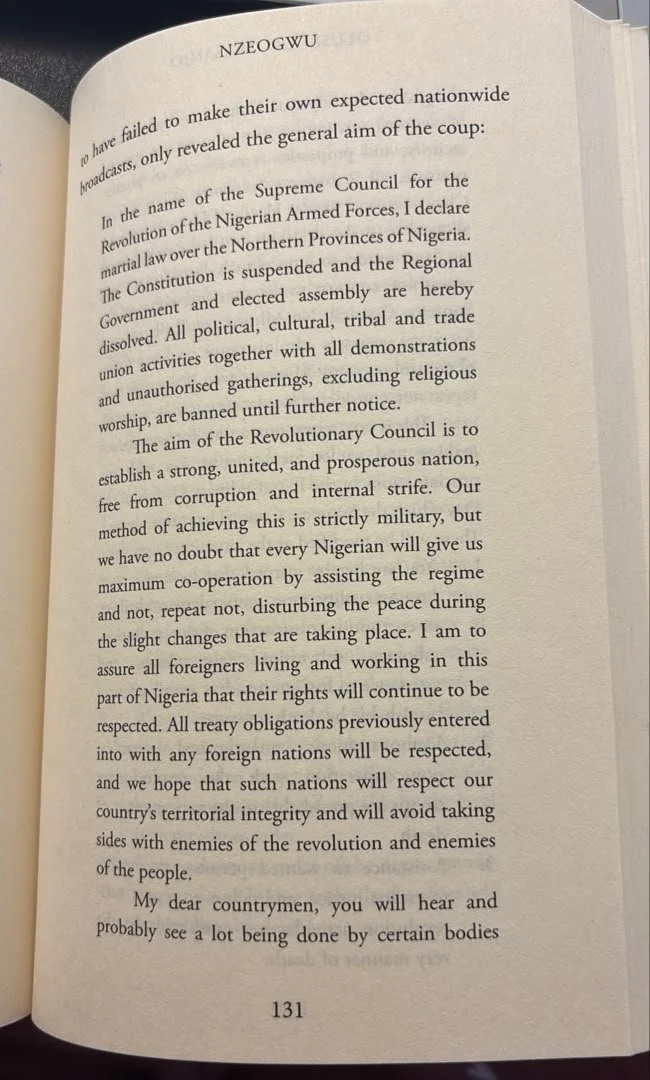
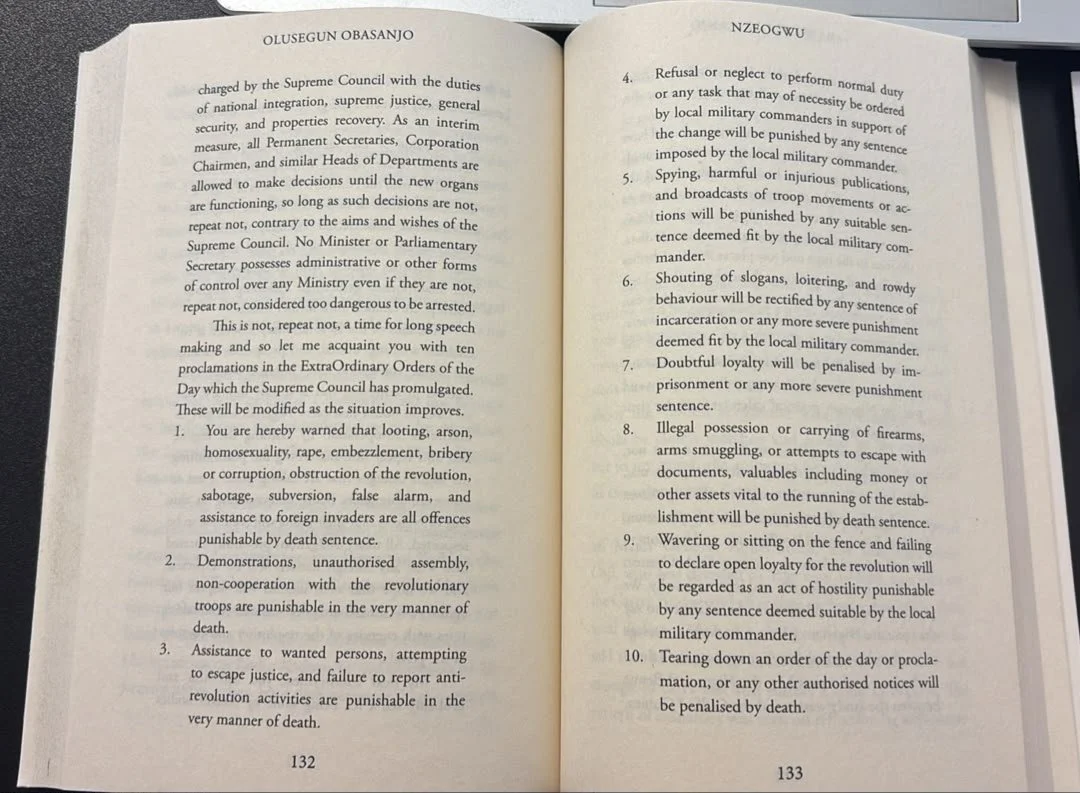
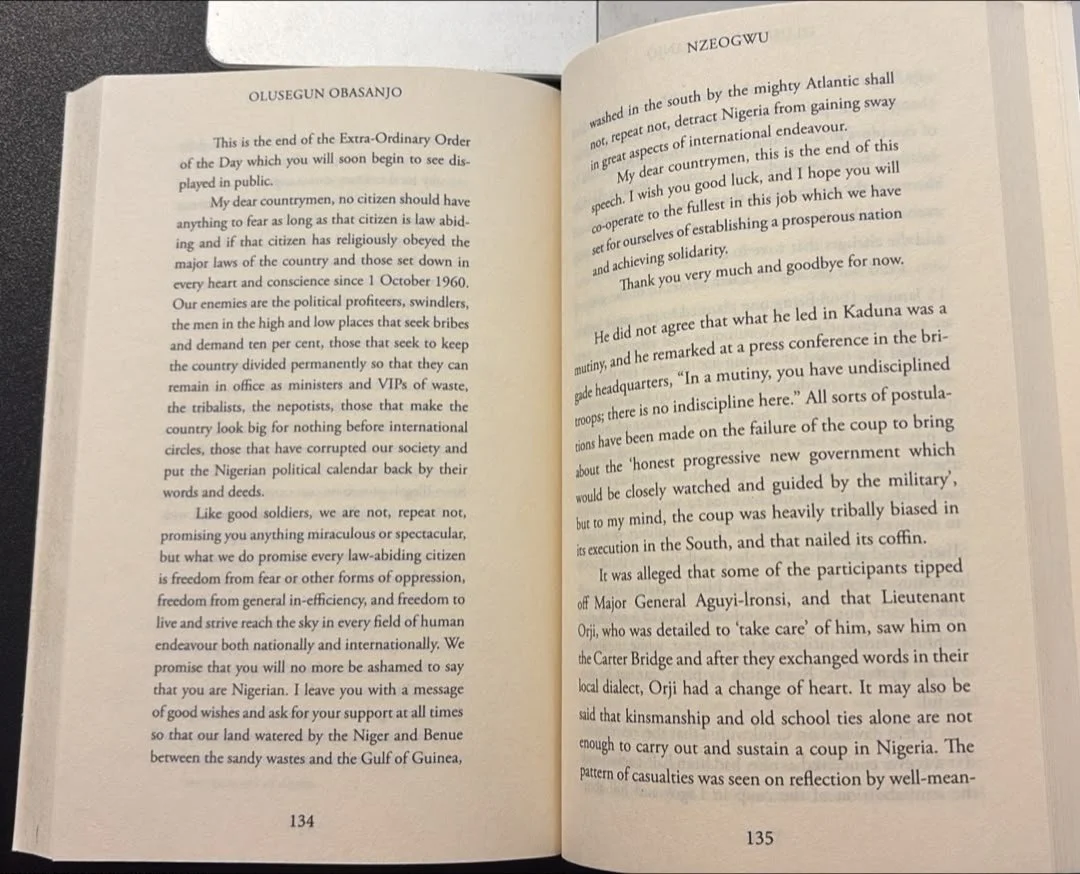
Nzeogwu’s May 1967 interview with Ejindu, shortly before the outbreak of the Nigerian Civil War.
“Chukwuma K. Nzeogwu has been known to me since 1960 when both of us served with 5 QONR in the Congo and he has been directly under me since February 1963. He has carried out his duty with diligence. Nzeogwu is resourceful, calm and calculated and has capacity for details. He has made remarkable improvement in his social outlook and now shows good signs of maturity. Nzeogwu is a devout Christian who is highly respected by his fellow officers. His bearing both during and off duty is excellent. A keen, young and promising officer who should do well in the Army.” — Lieutenant Colonel H.M. Njoku, in a report in July 1963.
“Major Nzeogwu took over as the college’s chief instructor last December. His main duties have been on planning and supervision of training. He has also acted as commandant for a short period. So far, he has carried out all these duties successfully and he is settling down well. Nzeogwu is keen and he devotes a lot of time to work. He has many good and up-to-date ideas acquired from his overseas courses and attachments. He is inclined to be easily upset when the views of others are contrary to his own, particularly officers of his own rank. Also, in his enthusiasm, he has the tendency to take too much for granted. I feel this is due to lack of experience. He has the capacity for hard work and details. He is reliable and should be very succesful either on the staff or at regimental employment with more experience. (He was given ‘A’ grading).” — Colonel R.A. Shodeinde, the commandant of the NMTC, in a report written in February 1965.
“Chukwuma was by nature and upbringing, incapable of planning, let alone executing a coup d’etat designed to deliberately suppress one tribe politically and elevate another.” — Olusegun Obasanjo
My Notes On Nzeogwu
Son of James Okafor and Elizabeth Mgbeke Nzeogwu
Full given name: Patrick Chukwuma Kaduna Nzeogwu
He was born on 26th of February 1937, in Kaduna. Given the catholic baptismal name “Patrick,” and Igbo name “Chukwuma.”
For several years, he was his parents’ only surviving child, having lost most of his siblings in childhood. It was only later that his parents had more children who survived. This experience helped shape his independent nature.
Paternal grand-father: Obi Nzeogwu (was a Christian convert)
Paternal grand-mother: Okwudibechi
From Umuomake, in Obodogwu, in present day Okpanam.
James (his father) was brought up as a devout catholic.
Mgbeke (his mother) was first married to Peter, James’s younger brother, with whom she had a son. Peter later died following a failed medical procedure. After two years of mourning, Mgbeke married James, who had little choice in the matter, as his mother had played a major role in bringing Mgbeke into the family. Mgbeke would later give birth to their son, Chukwuma Nzeogwu.
He was very protective of his mother against his father’s occasional abuse.
He always took good care of his family.
Nzeogwu is a shortened form of Nzebuogwu
He was affectionately called “Kaduna” by his parents’ friends and neighbors, as was customary for children born and raised in the city.
He was fluent in Igbo, Hausa, and English.
He had a catholic background and upbringing.
He had an almost obsessive love for sports and physical fitness.
He was quite outspoken from a young age.
Was quite strong willed.
He was labeled in a report in 1961 by Lt. Colonel Aguiyi Ironsi as showing “unrestrained national feeling,” perceived as a sign of immaturity.
Very clear from his letters to Olusegun Obasanjo that he considered “OBA” not just as a friend but also as a true brother.
Once declared to Obasanjo, his close colleague, that working for Africa was more important to him than getting married.
He was the first Nigerian army officer to work the military intelligence section of the army headquarters in Lagos, and helped to establish it.
Acquired land property in Lagos which he believed to be the best investment at the time.
Reading, playing indoor games, and listening to music, especially classical music, were his hobbies.
He was a voracious reader.
He was very particular about his books being taken care of, even after being led to Lagos, and while in prison, after the failed coup in the South.
He was not very fond of Ojukwu.
He initially opposed secession and was a committed Nigerian nationalist from his early years. This remained his position until the Biafran War, when his personal convictions led him to take on the responsibility of defending the Eastern Region.
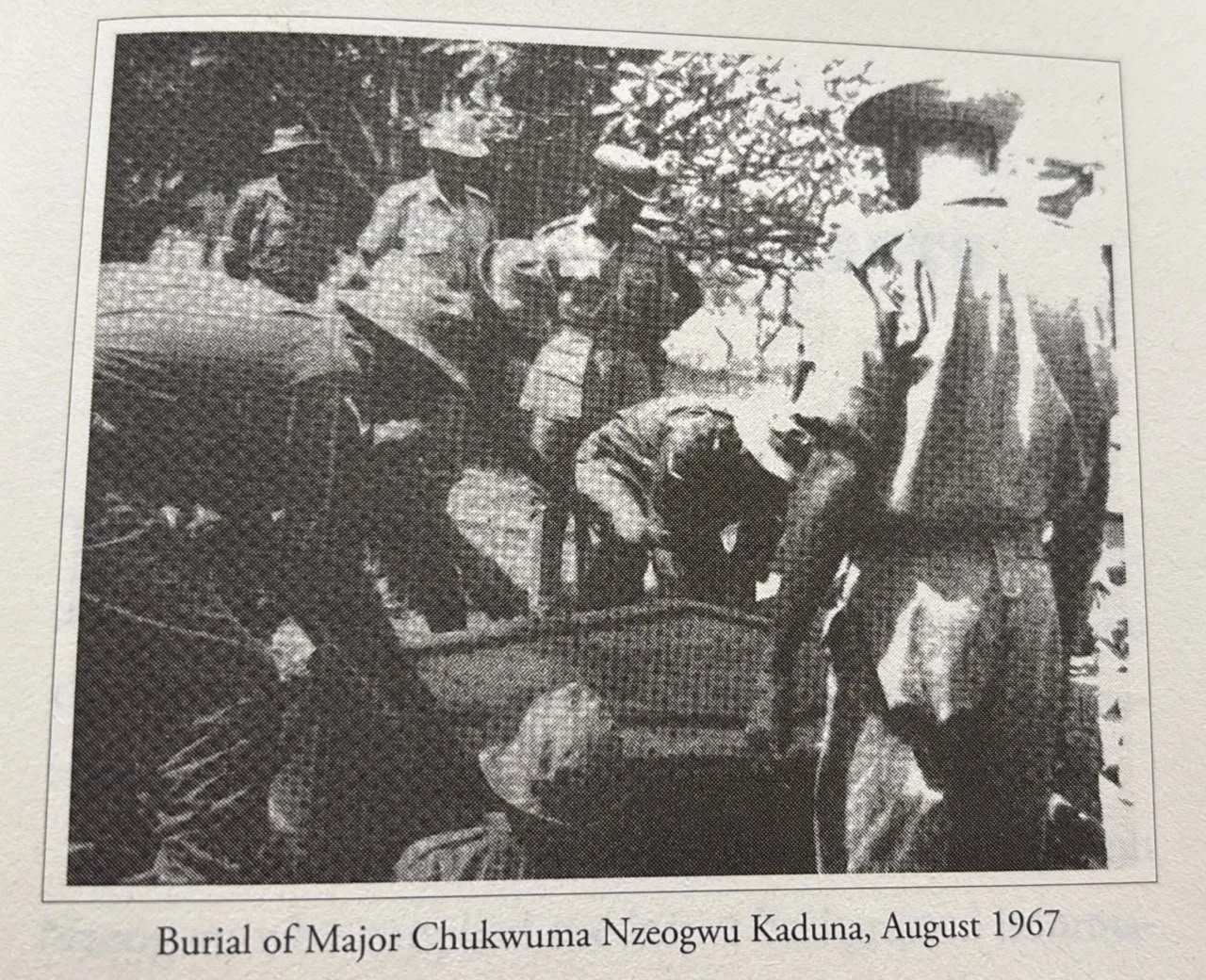
On the night of 29th July 1967, he died on the battlefield, fighting on the Biafran side.
His body was found by the federal (Nigerian) side on the 31st of July 1967; recovered and then taken to Kaduna where he was buried at the military cemetery there, in the very city where he was born.
He lived for thirty full years.