The 16 Afa Seeds (Words) With Their Regular Igbo & English Terminologies
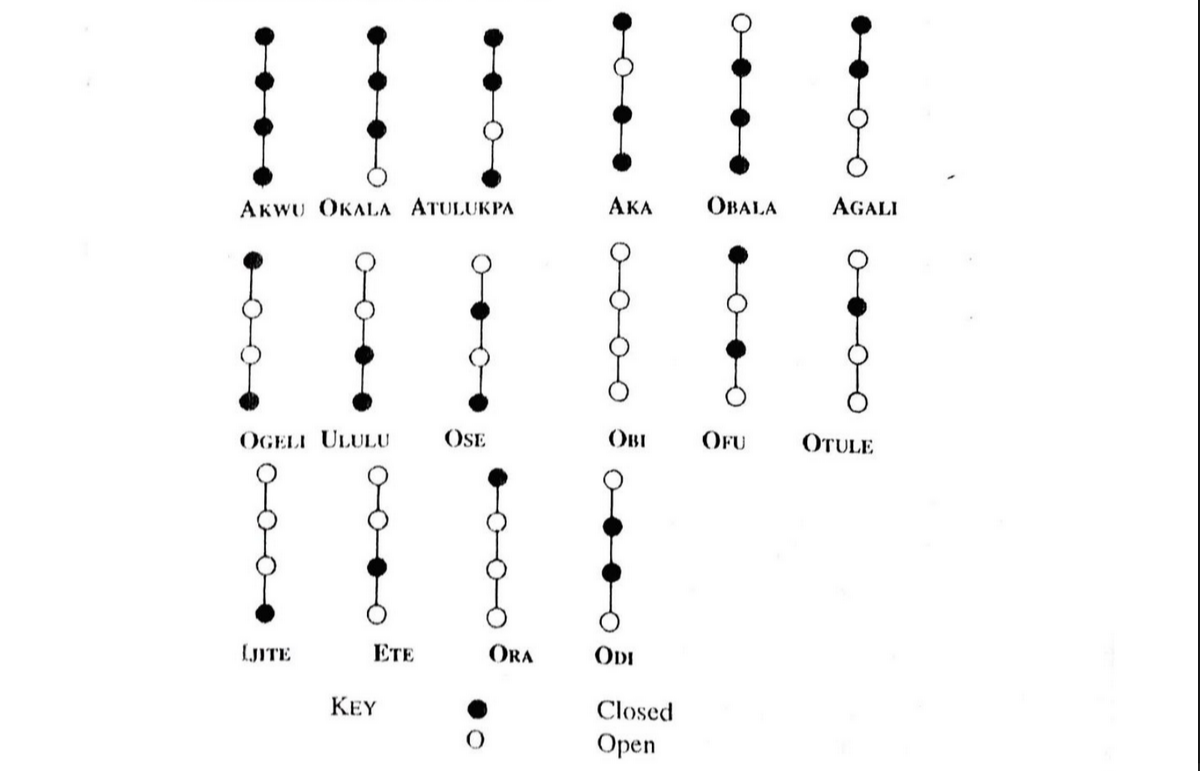
Afa Akpukpala (Ugiri) language, used primarily for divination and spiritual consultation in Igbo spirituality, consists of specific terminologies that usually differ from everyday (demotic) Igbo words.
Knowing these basic Afa words and their regular Igbo and English equivalents can provide deeper insight into your cultural and spiritual practices as an Odinani practitioner.
This article provides a general overview of the sixteen basic states of ‘elilie afa’ which are as follows: Aka, Akwu, Agali (Aghali), Atulukpa, Ete, Ijite (Ogwute), Obala, Oha (Ora), Okala (Okara), Ose, Obi (Ogbi), Odii, Ofu, Oghele/Ogeli/Ogoli/Ogholi, Otule, and Ululu.
Please keep in mind that this article simply offers basic insights for beginner friendly understanding. Afa Akpukpala mystic corpus is way more expansive and comprehensive than what is highlighted here.
Also keep in mind that Afa Akpukpala language may have deeper contextual interpretations, depending on usage and specific nuances as applied by expert mystics.
16 Afa Words With Their Regular Igbo & English Terms
1. Aka
Ordinary Igbo: Ijem | Njem
English: Journey | Proto state
Explanation: "Aka" in Afa signifies a journey or a path, similar to "ijem/njem" in regular Igbo, symbolizing one’s process or progression in life or spirituality.
2. Akwu
Ordinary Igbo: Ihe kwu otu ebe | Onodu | Ino ofu
English: Something standing still | Stillness | Patience | Staying in one place
Explanation: "Akwu" denotes something that is stationary or stable, it symbolizes steadiness or causal state.
3. Agali/Aghali
Ordinary Igbo: Ikenga | Ezi gbali mkpi ato
English: Ikenga | Strength | Three joined roads
Explanation: In both Afa and ordinary Igbo, "Ikenga" refers to a symbol of strength, achievement, and success, usually represented by an esoteric motif.
4. Aturukpa or Atunukpa or Atulukpa
Ordinary Igbo: Ndi Oyibo | Akwa | Udo | Ife e kedolu
English: Europeans | Foreign | Cloth | Udo deity | Something that is tied up
Explanation: In Afa, "Atulukpa" can refer to a foreign reality or cloth or Udo, symbolizing new external influences on a situation.
5. Ete
Ordinary Igbo: Ihe mbelede
English: Sudden event | Vibration
Explanation: "Ete" describes an unexpected or sudden occurrence, indicating surprise or abrupt changes.
6. Ijite or Ogwute
Ordinary Igbo: Okpololo ezi | Okpolo uzo | Owa
English: Main road | Natural wave | Path
Explanation: "Ijite" signifies the main road or beingness, representing a major path or route.
7. Obala or Obara
Ordinary Igbo: Oba | Ihe di n'ife | Ife ghere oghe
English: Contraction | An unhidden object | Something open
Explanation: "Obala" refers to something visible or not hidden.
8. Ora
Ordinary Igbo: Oku | Ife na-eke eke | Ubosi Eke | Agu-Nkwo (Agu-Nkwo-Eze-Ututu) |Nzu
English: Fire | Something that shines | Eke day | The hawk form of Agwu | Conqueror of the mornings | White clay
Explanation: "Ora" signifies light, representing cosmic light or something that stands out, shines bright.
9. Okala or Okara
Ordinary Igbo: Ihe kpogala akpoga | Ihe zogali azoga
English: Astride | Something wide | Something that was fought over
Explanation: "Okala" describes something wide or spread out, it can indicate a state that is neither here nor there.
10. Ose
Ordinary Igbo: Anya | Ihe ghere oghe
English: Eye | Something open | Portal | Potency
Explanation: "Ose" can mean eye or portal, symbolizing vision, perception, and divine insight.
11. Obi or Ogbi
Ordinary Igbo: Ojije | Ogiga | Igba izu
English: Movement | Dialogue | Finding a solution
Explanation: "Obi" or "Ogbi" indicates movement, signifying progress or changes in a state.
12. Odii
Ordinary Igbo: Neeli | Ndeli | Abani
English: Midnight | Darkness | Night
Explanation: "Odii" represents midnight, a time associated with deep spiritual activities or transitions.
13. Ovu or Ofu
Ordinary Igbo: Otu ihe | Afufu | Oru
English: One | Suffering | Work
Explanation: "Ovu" denotes the concept of one or unity, indicating singularity or wholeness.
14. Ogele or Ogoli or Ogheli
Ordinary Igbo: Nwaanyi | Onye na-aku ota | Iku ota
English: Woman | Someone that complains | Complaint | Absolution
Explanation: "Ogele" or "Ogheli" refers to a state of resolution, it symbolizes the feminine aspect or female presence in various contexts.
15. Otule
Ordinary Igbo: Okwu | Ikpe
English: Speech | Arbitration | Case | Trouble (disputed issue)
Explanation: "Otule" refers to speech or spoken words, it symbolizes energetic communication and expression.
16. Ululu
Ordinary Igbo: Ihe kpodolu akpodo
English: Hooked | Principle of gravity | Anchoring or Pinpointing
Explanation: "Ululu" describes something hooked or attached, it symbolizes a strong connection or attachment to the material realm.
In Conclusion
Knowing and understanding these 16 basic Afa terminologies and their regular Igbo and English equivalents not only improves one's knowledge of Igbo spirituality but can also deepen one’s appreciation for the intricate language and symbolism within the culture.
These words play important roles in divination, rituals, and daily spiritual practices, which illustrate the connection between language, spirituality, and life in Igbo society.


























Recommended Resources:
Afa Mystic Matrix System of Divination Study Guide| Odinani Mystery School
How to Correctly Read Afa Strings | Odinani Mystery School
The Basics of Afa Akpukpala Mystic Matrix-System of Divination & Oraculation| Odinani Mystery School
Join Odinani Mystery School for access to Exclusive in-depth teachings on ancient Igbo wisdom and mystical sciences!