When many people hear the term Ara Agwu, they immediately think of someone who has to become a Dibia or someone undergoing an intense spiritual awakening.
But in Igbo worldview, the signals of Agwu can also be much more subtle than people realize.
Long before someone understands what is happening, certain patterns may begin to appear in their life. These patterns are mostly dismissed as personality flaws, laziness, bad luck, or simply "that's just how they are."
Of course, it is important to remember that these experiences can have many different causes, including psychological, medical, emotional, or environmental ones. They should not automatically be interpreted as signs of Ara Agwụ.
However, within Odinani framework, they are sometimes regarded as possible expressions worth paying attention to, especially when they occur persistently and alongside other indicators.
Here are five that are commonly overlooked.
1. Spendthriftness
Some people seem to attract money with remarkable ease.
Opportunities come. People support them. Resources appear. Yet no matter how much they receive, they struggle to keep it.
Money flows through their hands almost as quickly as it arrives. This is not ordinary “generosity”. It is not simply enjoying life's pleasures.
It is a recurring inability to preserve what has been given.
Within the Odinani perspective, this may sometimes reflect an imbalance between receiving and stewarding one's gifts.
The lesson and necessary work here is to cultivate discipline alongside abundance.
2. Pathological Lying
Some people possess extraordinary imaginations. They are gifted storytellers. Creative, expressive, and full of ideas. But somewhere along the way, that creativity becomes untethered from truth.
They begin exaggerating then embellishing.
Eventually, they tell stories (create false narratives) even when there is no reason to do so. The urge becomes difficult to control.
Within the traditional understanding of Agwu, immense creative potential that lacks proper grounding can sometimes express itself in distorted ways.
The gift is not the problem. The absence of discipline is.
When creativity is directed toward meaningful work, truth, and service, it will become a blessing rather than a burden.
3. Self-Neglect
One of the quieter expressions people often ignore is persistent self-neglect.
A person may possess intelligence, talent, and ambition, yet continually struggle to care for themselves.
Simple tasks become overwhelming. Personal hygiene is neglected. Their living space falls into disorder. Their own well-being receives little attention.
It can feel as though the energy required to care for oneself is constantly unavailable.
In the Odinani perspective, caring for the body is not separate from caring for the spirit. The body is one of the first places where balance, or imbalance, becomes visible.
4. Sexual Deviance
Few topics are as misunderstood as this one.
Traditional thought sometimes views excessive or uncontrolled sexual impulses as creative energy seeking expression without healthy direction.
Creation itself is a powerful force.
When that force is not channeled into learning, building, teaching, art, innovation, healing, or meaningful work, it may seek other outlets.
This does not mean sexuality is inherently wrong. Far from it.
Rather, it reminds us that human creative energy can express itself in many ways.
The challenge is learning to direct that energy consciously instead of allowing it to dominate us.
5. Near Success Syndrome
Perhaps one of the most frustrating patterns is this. A person has brilliant ideas. They begin projects enthusiastically. They inspire others. They make rapid progress. Everything looks promising. Then...
They stop.
Typically because something prevents them from seeing the work through. This pattern repeats itself over and over.
New beginnings become easy, and completion becomes difficult.
Within the Odinani perspective, this can sometimes indicate that one's gifts have not yet been properly ordered, disciplined, or aligned with purpose.
Potential alone is never enough. Consistency is what transforms potential into destiny.
The Goal Is Balance, Not Fear
The purpose of recognizing these patterns is not to label yourself. Nor is it to assume that every personal struggle is spiritual in origin.
Rather, it is to encourage honest self-reflection.
Ask yourself:
What patterns keep repeating in my life?
Where do my greatest gifts become my greatest struggles?
What areas of my life consistently lack balance?
In many cases, awareness is the first step toward transformation.
To Sum It Up
Within Odinani, Agwu is a force that requires understanding, discipline, and proper direction. It is an energy that is meant to be consciously cultivated.
Many of the very qualities that create difficulty when left unmanaged can become extraordinary strengths when cultivated.
The person who struggles to keep money can learn stewardship. The compulsive storyteller can become a gifted teacher or writer.
The one who neglects themselves can learn the sacredness of self-care. The person overflowing with creative energy can channel it into meaningful creation. The individual who starts everything can develop the discipline to finish.
The invitation has always been to bring the gift into balance.
For that is one of the enduring lessons of Odinani; every powerful force in human life requires wisdom, discipline, and right direction if it is to become a blessing rather than a burden or a curse.







Recommended Resources:
Nne Agwu: The Totality Sum Form of Agwu | Odinani Mystery School
Ebo Agwu: The Particularized Form of Agwu | Odinani Mystery School
Multiple Ways We Can Understand Agwu from Afa | Odinani Mystery School
Agwu Ishi Ora (The Head of All Agwu) | Odinani Mystery School
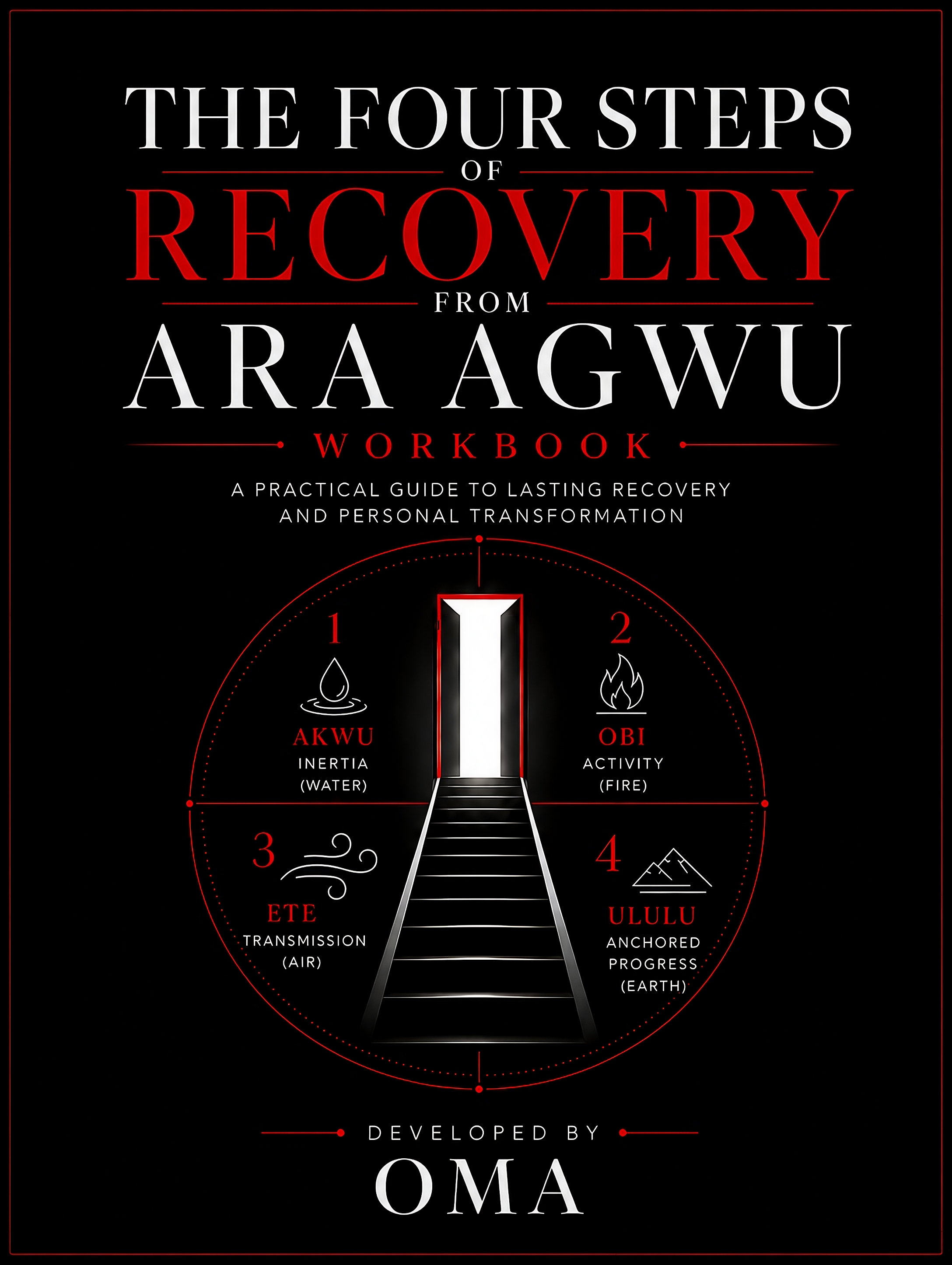
The Four Steps of Recovery From Ara Agwu (Workbook)
A practical reflection and recovery workbook designed to help seekers navigate the often complex journey of healing from Ara Agwu through a structured yet deeply personal approach.

Join Odinani Mystery School for access to Exclusive in-depth teachings on ancient Igbo wisdom and mystical sciences!