Phase Four is the stage of establishment.
By this point, the person has already moved through confusion, stagnation, revelation, activity, transformation, transmission, potency, and a clearer sense of being.
They have learned how to move, recognize meaning, live from new insight, as well as stand between spiritual intensity and ordinary reality without being completely torn apart by either.
Now the work changes again. The task now is to build a life that reflects recovery.
The four stages of Phase Four, as derived from Afa Akpukpala framework, are:
ULULU → AGALI → OGELI → OTULE
These stages describe the movement from anchored progress into active actualization, from actualization into absolution, and from absolution into fearless self-advocacy.
The guiding element of this phase is Earth.
Earth represents structure, consequence, stability, embodiment, responsibility, fertility, permanence, and physical reality.
The central instruction of Phase Four is: Build carefully, because what you establish now may shape the rest of your life.
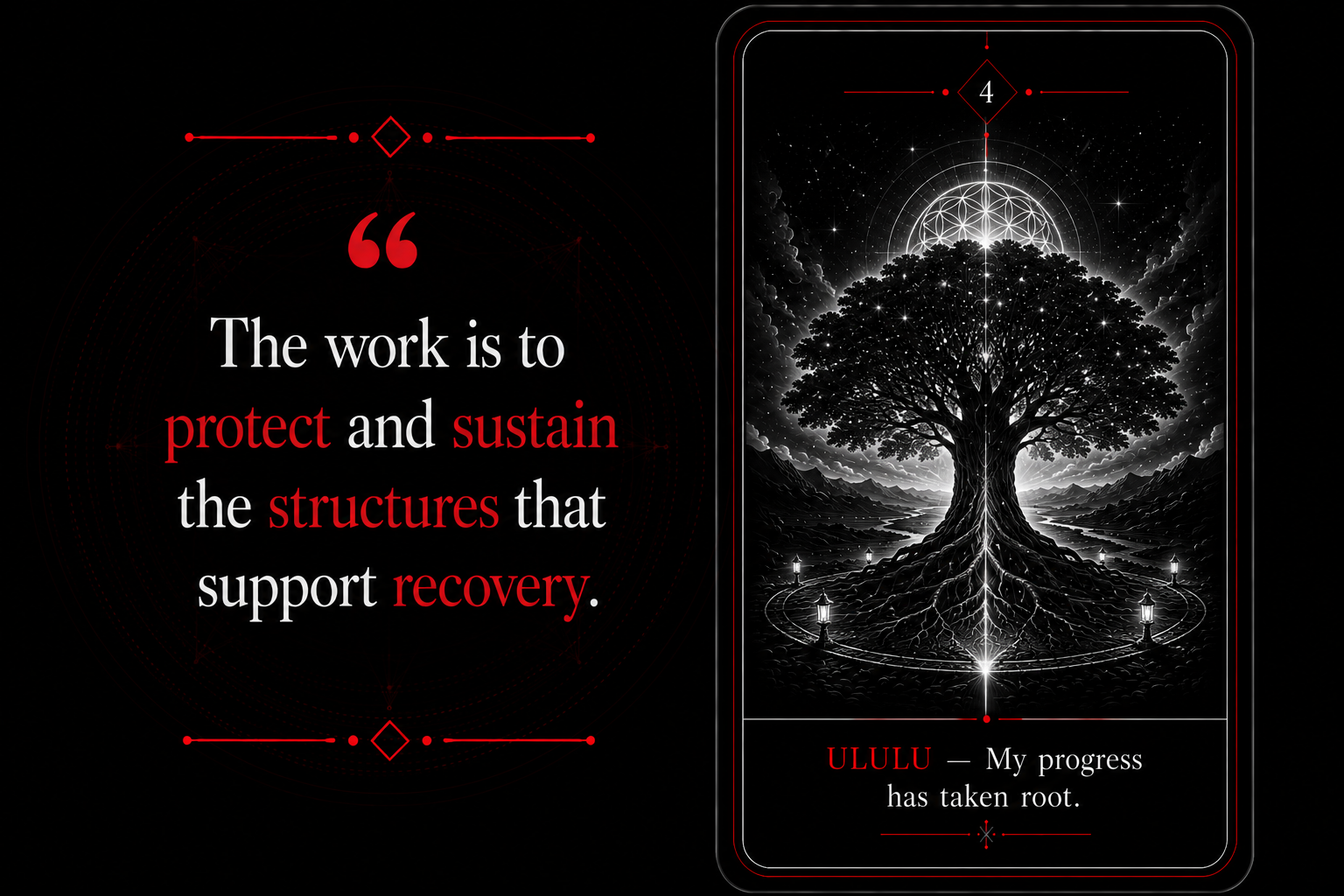
1. ULULU — Anchored Progress
Recovery is no longer only an internal possibility. It has become an established reality.
Ululu is the stage of anchored progress.
At this point, the person has transcended Phase Three. The changes they have undergone are no longer temporary flashes of clarity.
Their progress has become rooted. It has entered their habits, decisions, relationships, environment, and the way they interpret themselves and the world around them.
Their recovery has become part of who they are. This is what it means for progress to become anchored into the consciousness of the Earth.
The person may now possess healthier routines.
They may have a clearer relationship with work.
They may have learned to manage their spiritual sensitivity more responsibly.
They may now better understand their limits.
They may recognize their needs more quickly.
They may have established relationships, environments, boundaries, and practices that support their stability.
Their life begins carrying visible evidence of transformation.
At Ululu step, there is no true return to the earlier self. This does not mean the person can never struggle again. Or that they will never experience fear, confusion, grief, or spiritual difficulty.
It simply means they can no longer become completely unconscious of what they have learned.
They have seen too much, understood too much, and become too aware of themselves to fully return to the old reality.
This is anchored progress. The root has become established in the soil. The tree may still face wind, drought, or storm, but it is no longer a seed floating without direction.
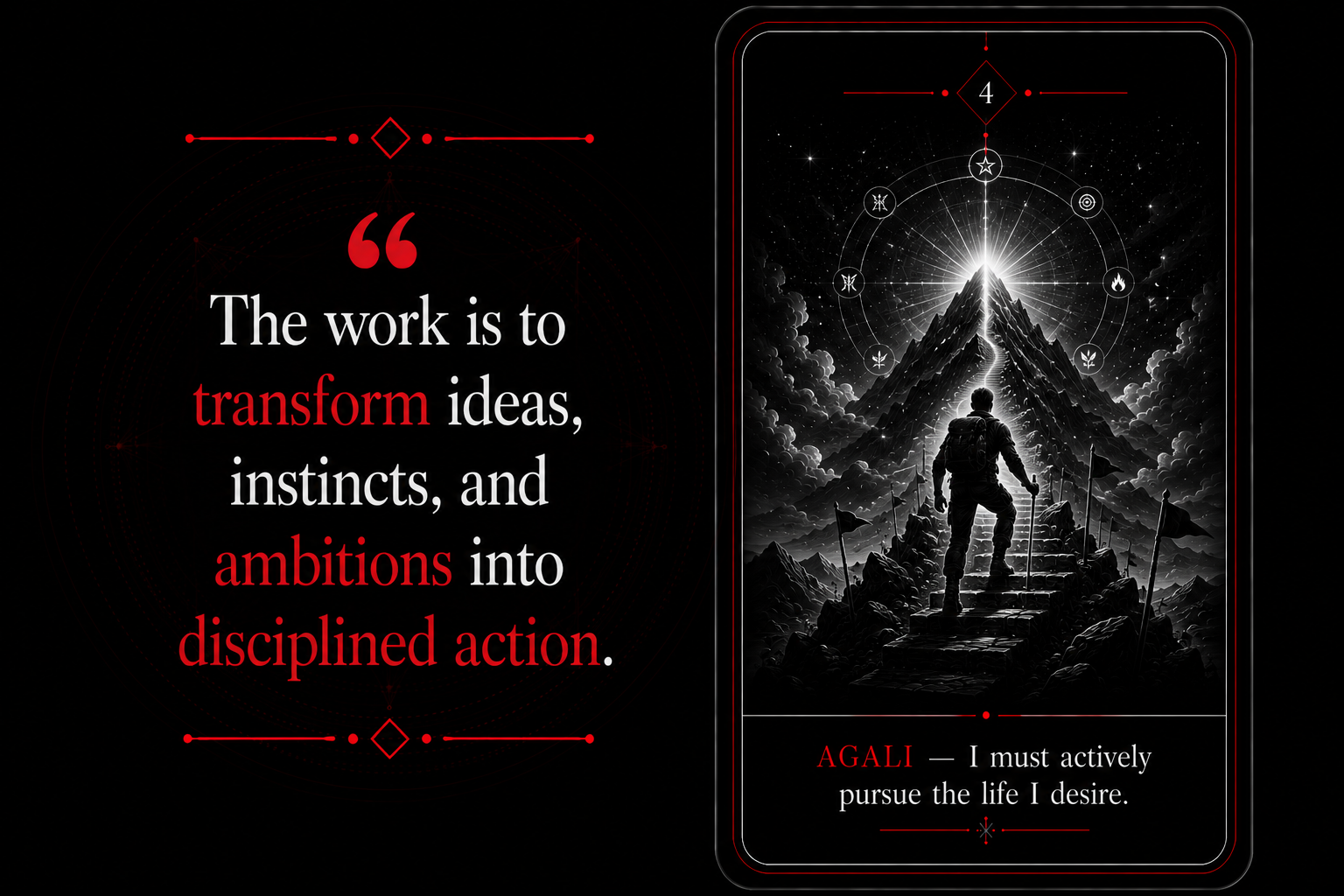
2. AGALI — Pursuit of Actualization and Success
The life you have recovered must now be used.
Agali is the pursuit of actualization and success. At this stage, one must continue applying steady effort toward the life they wish to create.
Recovery creates capacity, but that capacity must be directed.
A person may possess clarity, insight, spiritual awareness, creativity, intelligence, and strong intuition, yet still fail to build anything meaningful if they do not act.
Agali is therefore a stage of movement within structure.
The person must act on ideas. They must pursue opportunities. They must trust their instincts while also applying practical judgment. They must take calculated risks. They must develop discipline and become willing to ask for what they want.
At this stage, one must be willing to work for what they desire. They must move beyond endlessly imagining a better life and begin constructing it.
This is where recovery becomes deeply physical. The person may need to change their work. Develop a skill. Start a business. Complete an education. Build a home. Improve their finances. Strengthen their health. Create art. Pursue leadership. Deepen relationships. Serve their community. Raise a family.
Travel, teach, write, speak, organize, build. Whatever actualization means for the individual, Agali asks them to pursue it with consistency.
The important word here is aligned effort.
The person must continue using the discernment gained in earlier phases. Success without alignment can become another form of imprisonment.
A person may achieve something impressive and still find themselves living a life that does not belong to them.
Agali therefore asks:
What does success mean to me now?
What am I actually trying to build?
Which desires are truly mine?
Which ambitions were inherited from family, society, fear, comparison, or insecurity?
What kind of achievement supports my spiritual and earthly well-being?
The purpose of this stage is the conscious pursuit of a reality that reflects who the person has become.
You must act on your ideas, but your ideas must also be examined. You must trust your instincts, but your instincts must also be disciplined. You must pursue your desires, but your desires must not become your master.
Actualization requires both hunger and wisdom.
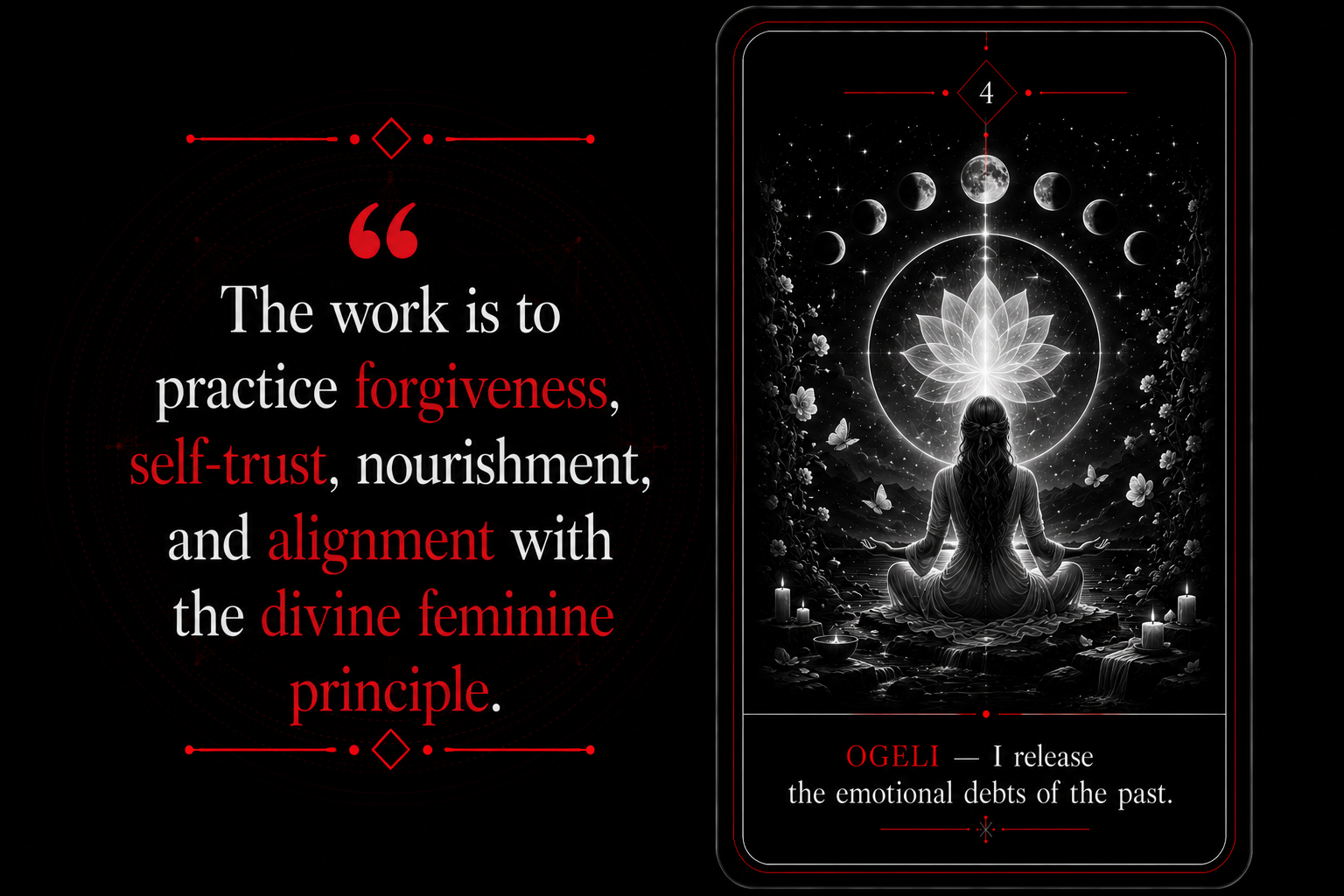
3. OGELI — Absolution
You cannot fully inhabit a new life while continuously prosecuting yourself for the old one.
Ogeli is absolution. At this stage, the person must develop complete trust in their ability to continue progressing.
They must begin releasing guilt, regret, shame, and negative emotional attachments to the past. This includes the experiences connected to Ara Agwu.
Many people recover outwardly while remaining internally committed to self-punishment. They may build a new life yet continue speaking about themselves as though they are still trapped in the old one.
They may continue carrying shame about what happened, or regret how they behaved while confused. They may feel guilty about relationships they damaged, or resent the years they lost.
They may remain angry with themselves for not understanding sooner, or fear that their past disqualifies them from peace.
Ogeli says: Enough.
There comes a point when the past must stop being used as evidence against the self.
Absolution is not avoidance. It is neither pretending nothing happened, nor refusing to repair harm where repair is possible. It is also definitely not rewriting the past to make oneself innocent of every mistake.
Absolution is the decision to stop making suffering the permanent punishment for being human. You can acknowledge what happened, accept responsibility, apologize, repair what can be repaired, and learn. Then you must continue living.
At Ogeli, the person is called to embody the divine feminine, motherly principle. This principle exists in everyone, regardless of gender.
It is the part of the self that knows how to hold pain without becoming pain. It nurtures, receives, restores, protects and forgives without becoming foolish.
It creates boundaries without abandoning compassion. It knows when to intervene and when to allow growth. It understands that sometimes strength is the ability to hold oneself gently enough to continue growing.
The divine feminine principle also reminds us that life grows through nourishment. A person cannot endlessly curse the soil and still expect it to produce fruit.
Your internal world must become somewhere life can grow. This means changing the way you speak to yourself. Changing the way you interpret your past. Changing the emotional environment within which your future is developing.
You cannot continue referring to yourself only as broken, cursed, lost, unstable, or damaged and expect those words to have no effect.
The mind, body, and spirit listens. The Earth itself responds to repetition.
Ogeli teaches that forgiveness is a spiritual and practical discipline.
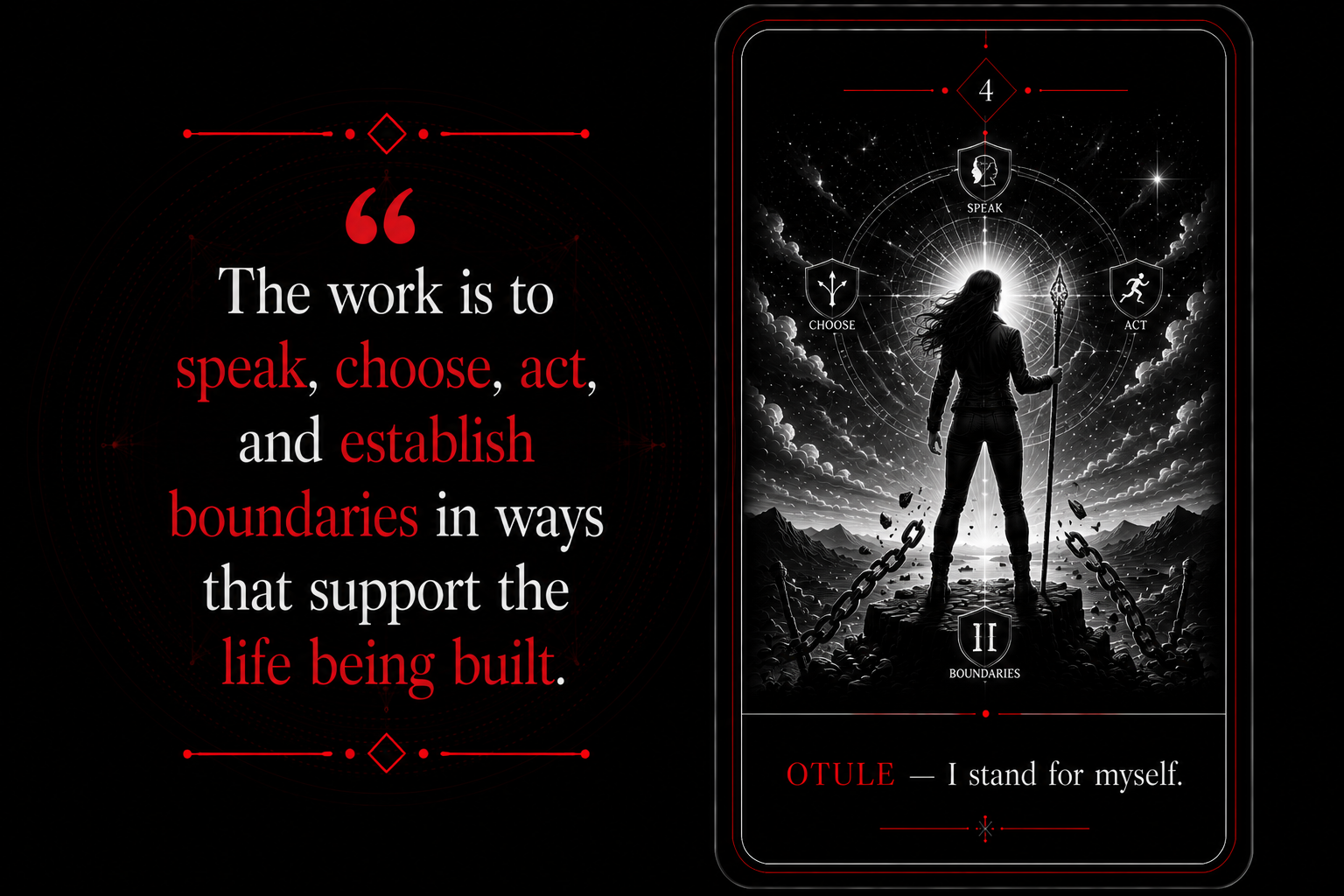
4. OTULE — Self-Advocacy
You must become willing to stand publicly behind the person you have become.
Otule is self-advocacy. At this stage, one must stand for themself. They must speak for their interests, protect their needs, and become willing to express their beliefs with clarity.
They must stop shrinking merely to make others comfortable. This is especially important for those whose experiences have been misunderstood, ridiculed, dismissed, or interpreted only through fear.
Recovery cannot be fully sustained if a person remains unable to defend the conditions that make recovery possible.
You may know what you need internally, but can you communicate it? You may understand your limits, but can you enforce them?
You may know what path is right for you. But can you continue walking it when others disagree?
Can you say no when confronted with things you understand to be harmful? Can you speak about your vision without apologizing for existing?
Otule demands a new relationship with voice. The person must learn to speak constructively about themselves. This means refusing to participate in your own erasure.
At this stage, what you believe and say about yourself matters greatly. Your self-description becomes part of the structure of your reality.
If you continuously describe yourself as helpless, your actions may begin organizing themselves around helplessness. If you constantly insist that your past has destroyed your future, you may begin refusing opportunities that challenge that belief.
If you believe that no one will understand you, you may stop communicating clearly and then use the resulting confusion as evidence that you were right.
Words do not only describe reality. They also have the ability to influence the way reality is approached.
Otule therefore asks the person to become intentional with language.
Speak truthfully.
Speak responsibly.
Speak courageously.
Do not exaggerate yourself. But do not diminish yourself either. There is no spiritual virtue in pretending to be smaller than you are.
Self-advocacy may involve setting boundaries. Asking for support. Refusing mistreatment. Seeking professional help. Explaining your needs. Defending your work. Negotiating fairly. Leaving harmful environments. Speaking openly about your beliefs.
Choosing not to participate in systems that repeatedly destabilize you. It may also require being misunderstood. Not everyone will celebrate your clarity.
Some people benefited from your confusion. Some preferred your silence. Some will also call your boundaries disrespect.
They will call your confidence arrogance and label your independence as rebellion.
You must still learn how to stand on self-belief regardless.
The Guiding Element of Phase Four: EARTH
The guiding element of Phase Four is Earth.
Earth is where things become real.
Ideas may emerge through Air. Illumination may come through Fire. Movement may begin through Water. But Earth determines what becomes embodied.
Earth concerns the physical consequences of choices.
Work.
Money.
Health.
Home.
Family.
Reputation.
Community.
Routine.
Commitment.
Responsibility.
Legacy.
Phase Four has the greatest direct effect on physical reality because the actions taken here are repeated, structured, and sustained.
A single decision can become a habit. A habit can become a lifestyle. A lifestyle can become a destiny. This is why Phase Four must be approached with seriousness. The person is now at a phase where they are establishing patterns that may influence the rest of their life.
Earth teaches that everything planted has consequences. A seed does not become a tree through intention alone. It must enter the soil, be watered, receive light, survive seasons, and grow roots before it can carry weight.
In the same way, a new reality must be maintained. You cannot plant once and refuse to return to the field. You must continue tending what you have created.
Your Decisions Now Have Weight
Earlier in recovery, the person may have been primarily concerned with surviving confusion.
At Phase Four, the question becomes: What will you do with the life that has been returned to you?
Your decisions now have weight. The people you choose, the habits you establish, the work you pursue, the way you spend money, use your body, respond to conflict, speak about yourself, and organize your time, all matter.
The environments you repeatedly enter, and the person you become through repetition also matter. The implication of this is that repeated decisions create structure.
Earth is patient. It responds to what is done consistently.
A person may claim to desire peace while repeatedly choosing chaos. They may claim to value health while continuously neglecting the body. Or claim to desire success while refusing disciplined effort.
They may even claim to value freedom while repeatedly returning to relationships that require self-abandonment.
Earth responds to patterns. What you repeatedly do becomes the strongest statement of what you believe.
Recovery Must Become Sustainable
Phase Four is concerned with sustainability.
Can you maintain what you have learned?
Can you continue your practices when you are no longer in crisis?
Can you protect your clarity when life becomes busy?
Can you remain grounded when success arrives?
Can you continue caring for yourself when no one is watching?
Can you preserve your boundaries when affection is involved?
Can you remain honest when dishonesty would be more profitable?
Can you continue honoring your path after the excitement of discovery has passed?
These questions matter because some people know how to transform but do not know how to sustain transformation. They know how to begin but do not know how to continue.
Earth teaches continuation. It teaches repetition, maintenance, and the dignity of ordinary discipline. There is something deeply spiritual about doing what supports your life again and again.
Sleeping properly, eating right, working, resting, saving, cleaning, planning, following through, keeping promises, correcting mistakes, and maintaining relationships.
These actions may not appear mystical, but they create the foundation upon which a stable spiritual life can exist.
There is little benefit in receiving great spiritual insight while continuously living in physical disorder.
There Is No Going Back—But There Is Still Responsibility
Ululu step teaches that progress has become anchored. But anchored progress should never be confused with guaranteed perfection.
There may be no true return to complete unconsciousness, but there can still be neglect. There can still be self-sabotage, avoidable suffering, or even certain consequences.
The statement “there is no going back” does not imply one can now behave carelessly. It means the person has crossed an internal threshold. They can no longer unknow what they now know.
They can no longer comfortably return to old illusions. But they must still choose what they will build with that awareness.
This is why the final phase places such great emphasis on responsibility. Freedom without responsibility will result back to bondage.
Phase Four asks the person to become dependable to themselves.
Can you trust yourself with your own future?
That may be the deepest question of this stage.
The Four Movements of Phase Four
The progression of Phase Four can be understood simply:
ULULU — My progress has taken root.
The work is to protect and sustain the structures that support recovery.
AGALI — I must actively pursue the life I desire.
The work is to transform ideas, instincts, and ambitions into disciplined action.
OGELI — I release the emotional debts of the past.
The work is to practice forgiveness, self-trust, nourishment, and alignment with the divine feminine principle.
OTULE — I stand for myself.
The work is to speak, choose, act, and establish boundaries in ways that support the life being built.
Together, these movements complete the journey from internal crisis into embodied reality.
Phase Four teaches establishment.
To Sum It Up
The central lesson of Phase Four is this: Your recovery must become a place you can live.
At this stage, you have survived, learned, and changed enough. Now build.
Build in a way that honors both your spiritual nature and your physical life.
Do not continue punishing yourself for the person you were while trying to become the person you are meant to be.
Do not remain silent when silence threatens what you have built.
Do not wait endlessly for permission to pursue your life.
Take responsibility for your desires. Act on your ideas. Trust what experience has taught you. Release the guilt that no longer serves growth. Speak constructively about yourself. Stand for the reality you have fought to create.
Earth remembers what is repeatedly placed into it. So plant carefully. Whatever you plant now may become the ground upon which the rest of your life stands.
May your progress take root, your actions become evidence, and your life be filled with joy.
Jisie ike.









Recommended Resources:
Nne Agwu: The Totality Sum Form of Agwu | Odinani Mystery School
Ebo Agwu: The Particularized Form of Agwu | Odinani Mystery School
Multiple Ways We Can Understand Agwu from Afa | Odinani Mystery School
Agwu Ishi Ora (The Head of All Agwu) | Odinani Mystery School
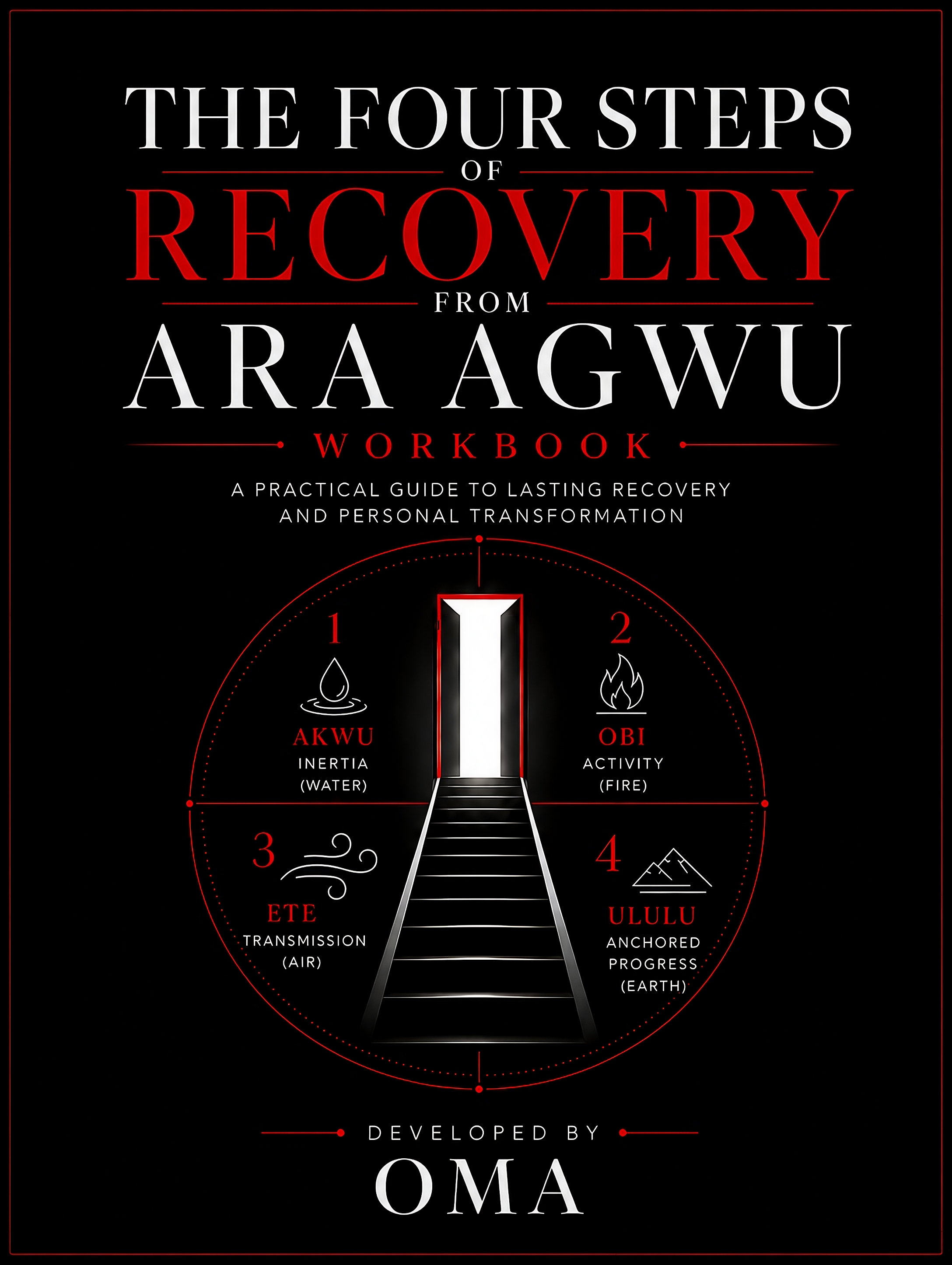
The Four Steps of Recovery From Ara Agwu (Workbook)
A practical reflection and recovery workbook designed to help seekers navigate the often complex journey of healing from Ara Agwu through a structured yet deeply personal approach.

Join Odinani Mystery School for access to Exclusive in-depth teachings on ancient Igbo wisdom and mystical sciences!