Recovery from Ara Agwu is rarely a simple or predictable process.
It may involve confusion, deep inner work, sudden changes, spiritual pressure, periods of clarity, setbacks, breakthroughs, and the gradual rebuilding of one’s relationship with life.
Although every person’s experience will differ, the recovery journey can be understood through four broad steps derived from Afa Akpukpala framework: AKWU → OBI → ETE → ULULU
Each step represents a different stage of movement, awareness, transformation, and stability.
They are also guided by four elemental forces: Water → Fire → Air → Earth
These elements describe the nature of the work required at each stage.
Water cleanses and restores movement.
Fire awakens activity and alignment.
Air carries insight into a new reality.
Earth anchors transformation into daily life.
Together, these four steps describe the movement from stagnation into sustained recovery.
1. AKWU — Inertia
The work of this step is to begin moving again.
Akwu is the first and often one of the most difficult steps of recovery.
At this point, the qualities associated with feeling stuck are still heavily amplified. There may be confusion, doubt, fear, worry, exhaustion, a lack of motivation, and a sense that life has slowed down or stopped completely.
Even when the person knows that something must change, they may struggle to gather enough energy, clarity, or confidence to begin changing it.
This is the state of inertia.
The person may feel as though they are watching life happen from a distance. Simple responsibilities can feel unusually difficult.
Decisions may become overwhelming. The future may be hard to imagine. Old questions may repeat themselves without producing answers.
There may also be periods when the person appears to make progress, only to become discouraged when that progress feels slow or inconsistent.
This does not mean recovery is impossible. It’s actually an indication that recovery is still taking place beneath the surface.
Akwu is a stage of cleansing, uncovering, resetting, and preparation.
The Element of Akwu Step —> Water
Akwu is ruled by the element of Water.
Water represents cleansing, emotional depth, movement, adaptation, and renewal.
During this stage, a great deal may still be hidden beneath the surface.
The person may be uncovering fears, memories, attachments, habits, wounds, spiritual questions, or patterns they did not previously understand.
Some of this work may feel repetitive. The same emotions may return. The same questions may appear in different forms. The person may even wonder whether they are making any progress at all.
But cleansing is not always immediate. Water often has to pass through the same space repeatedly before it becomes clear.
The most important task during this Akwu step is therefore to remain open to movement. The person does not need to understand everything before taking the next step. They only need to resist complete stagnation.
Walk.
Rest.
Clean the environment.
Spend time in nature.
Speak to someone trustworthy.
Write down what is being experienced.
Complete one manageable responsibility.
Change something small.
Seek help where necessary.
The movement does not have to be dramatic, but it has to be real.
At Akwu stage of recovery, the first victory is refusing to remain completely still.
The Danger of Akwu
The greatest danger at this stage is believing that slow progress means no progress.
When results are not immediately visible, the person may become hopeless. They may abandon helpful practices, isolate themselves, become convinced that their present condition is permanent.
But recovery often begins before the person can recognize it.
A small shift in routine or a moment of honesty may be progress.
The ability to name what is happening and willingness to receive support may be progress.
Even becoming tired of an old condition can be the beginning of movement away from it.
Akwu teaches patience.
It teaches the person to continue doing what they understand while allowing the unclear aspects of the journey to reveal themselves gradually.
2. OBI — Activity
The work of this step is to follow what produces meaningful progress.
Obi begins when activity starts returning.
The person may not feel completely recovered, but life no longer appears entirely frozen. Ideas begin to emerge. Opportunities become more visible. Energy starts returning.
The person may feel drawn toward certain projects, practices, relationships, responsibilities, or changes that support their progress.
The important distinction is that Obi is focused on becoming active in ways that are meaningful and aligned.
A person can fill every hour of the day and still remain internally stagnant.
The activity of Obi is different. It carries direction. A handful of things begins to make sense.
The person may discover a practice that helps. They may receive useful guidance, meet people who support their growth, or begin work that feels purposeful.
They may also become more consistent in caring for their body, environment, finances, relationships, or spiritual life.
They begin seeing that certain actions produce clearer results.
This is where the principle of seeking and finding, asking and receiving becomes important.
When a useful path reveals itself, it should be explored.
Recovery at this stage depends on the willingness to follow constructive leads.
The Element of Obi Step —> Fire and Light
Obi is ruled by Fire, or more broadly, Light.
Fire represents activity, illumination, conviction, courage, purpose, and transformation.
Water begins movement. Fire gives that movement direction.
At Obi, the person begins recognizing what brings warmth back into life. They start to identify certain activities that increase clarity, relationships that restore confidence, environments that create energy, decisions that produce peace, or forms of work that awaken purpose.
These experiences are signs of alignment.
Once that fire begins burning, it must be protected. The person should continue doing what strengthens their sense of direction.
They should also reduce unnecessary contact with whatever repeatedly extinguishes their progress.
This may require discipline, setting boundaries, leaving old habits behind, or choosing a difficult but meaningful path over an easy but destructive one.
Regardless, the fire must be fed.
Insight without action will eventually lead to frustration.
Obi therefore asks the person to turn clarity into repeated activity.
The Danger of Obi
The danger at this stage is either doing too little or trying to do too much.
Some people receive new energy but become afraid to trust it. They hesitate and question every opportunity. They return to old routines because familiarity feels safer than progress.
Others become so excited by renewed activity that they overextend themselves.
They take on too many responsibilities, attempt to rebuild every part of life at once, burn through their energy and mistake exhaustion for failure.
The work of Obi is sustained, aligned activity, not uncontrolled activity.
Move with purpose, but do not consume yourself in the process.
A healthy fire produces light and warmth.
An unmanaged fire destroys the structure meant to contain it.
3. ETE — Transmission
The work of this step is to allow inner transformation to reshape external reality.
Ete brings sudden movement.
At this step, the person may experience rapid changes, new ideas, greater clarity, and a stronger sense of alignment.
The work completed during Akwu and Obi steps begins producing visible results.
Effort starts turning into evidence. Inner changes begin transmitting themselves into physical life. The person may notice that decisions become easier and discernment becomes stronger.
They recognize harmful situations more quickly and understand their own needs more clearly.
They may begin speaking with greater confidence. Relationships may change. Opportunities may increase. Creative ideas may arrive suddenly. A new direction may become obvious.
The person may also feel freer because the rewards of their earlier work are beginning to appear.
This freedom can feel surprising.
After a long period of heaviness, the person may suddenly realize that they are no longer responding to life in the same way.
Things that once created intense confusion may now be easier to understand. People who once controlled their emotions may no longer have the same influence. Situations that once appeared impossible may now seem manageable.
This is transmission.
What has changed internally begins changing the world around the person.
The Element of Ete Step —> Air
Ete is ruled by Air.
Air represents communication, transmission, movement, perspective, breath, freedom, and intuitive intelligence.
Air carries what has been produced by the earlier elements. It carries moisture, heat, sound, seeds.
In the same way, Ete carries the person’s internal transformation into new spaces.
The person may also find that intuitive guidance becomes easier to understand. They are less likely to confuse every fear with a warning or every impulse with spiritual direction.
Discernment begins to mature because the person has accumulated enough experience to recognize their own patterns.
They begin understanding the difference between intuition and anxiety, as well as the difference between genuine alignment and temporary excitement.
The Importance of Lightness
Because Ete is governed by Air, the person must learn to remain lighthearted.
This does not mean pretending the experience of Ara Agwu was not serious, or denying pain.
It simply means refusing to let the gravity of the past become the only force shaping the future.
A person who has suffered deeply may unconsciously believe they must remain serious at all times.
They may feel guilty for laughing, resting, enjoying ordinary life, or moving forward while parts of the past remain unresolved.
But lightness is also part of recovery.
Play, joy, humor, rest, beauty, and ordinary pleasure matters.
Sometimes the clearest evidence of progress is the ability to enjoy a good day without feeling compelled to turn it into a spiritual lesson.
Air reminds the person to breathe.
The past may have been heavy, but the future does not have to carry the same weight.
The Danger of Ete
The danger at this step is becoming so excited by sudden progress that one loses grounding.
Freedom can become instability when it is not supported by discipline. Insight can also become confusion when every thought is treated as a revelation. And intuition can become recklessness when practical consequences are ignored.
The person should enjoy the new freedom while continuing to maintain ordinary structures.
Sleep. Eat properly. Handle responsibilities. Maintain trustworthy relationships. Work consistently. Observe results.
Do not abandon common sense simply because spiritual clarity has increased.
Air creates movement, but without grounding it can scatter everything it carries.
4. ULULU — Anchored Progress
The work of this step is to sustain the new reality.
Ululu is the final step of recovery.
At this point, the progress made through the earlier stages becomes anchored into the person’s consciousness, existence, habits, and daily life.
Recovery becomes visible. The person’s choices begin reflecting stability.
Their relationships may become healthier. Their work more consistent. Their environment more supportive. Their self-understanding may become clearer.
And their boundaries may also become stronger. The transformation is evident to everyone around them. Those around them may notice the difference. The person may carry themselves differently. They may respond to pressure with more patience.
They may make decisions with greater confidence, and become more responsible for their physical reality. This is what it means for progress to become anchored.
The change has taken root.
The Element of Ululu Step —> Earth
Ululu is ruled by Earth.
Earth represents stability, material reality, structure, responsibility, fertility, consequence, and continuity.
Recovery must become embodied.
Earth asks:
What habits now support this new reality?
What environments allow it to continue?
What work sustains it?
What relationships strengthen it?
What boundaries protect it?
What decisions will carry it into the future?
At Ululu, the person must use material principles to sustain spiritual progress. This includes caring for the body. Managing money responsibly. Maintaining a stable environment. Developing useful skills. Keeping commitments. Building routines. Choosing relationships carefully. Taking responsibility for consequences.
Recovery becomes practical.
A person may have experienced powerful insight, but insight alone cannot pay bills, maintain health, protect boundaries, or create a sustainable future.
Earth requires action. It responds to repetition.
What is done consistently becomes structure. And what takes on structure begins shaping destiny.
There Is No Going Back
At Ululu, the transformation has become too deeply integrated for the person to fully return to the earlier state of unconsciousness.
This does not mean they will never struggle again. Or that there will be no difficult days, or that they can abandon the practices that helped them recover.
It simply means they have crossed an internal threshold. They now know too much to become exactly who they were before.
They may briefly revisit old emotions, but they now recognize them. They may encounter confusion, but they possess more tools for navigating it.
The old life may still call to them, but it can no longer convincingly pretend to be the only possible reality.
That is anchored progress.
The Danger of Ululu
The danger at this final step is assuming that progress will sustain itself automatically. It will not.
Anything living must be maintained. The person must continue practicing what supports stability. They must continue adjusting when reality changes, and avoid becoming careless simply because life has improved.
A recovered life still requires attention. Ululu is not an invitation to stop doing the necessary work. It is the stage where work becomes more constructive, more visible, and more deeply connected to the future.
The Elemental Journey of Recovery
The four steps can be understood through their elemental movement:
WATER — AKWU
Water cleanses what has accumulated. It restores circulation.
It begins loosening what has become stagnant.
The lesson is: Remain open to movement.
FIRE — OBI
Fire gives warmth, energy, clarity, and direction.
It turns renewed movement into purposeful action.
The lesson is: Follow what brings meaningful progress.
AIR — ETE
Air carries the internal transformation outward.
It creates space, perspective, expression, and freedom.
The lesson is: Allow your new understanding to reshape your reality.
EARTH — ULULU
Earth gives the transformation structure.
It turns progress into routine, stability, and material evidence.
The lesson is: Build a life capable of sustaining your recovery.
This elemental progression can also be summarized simply:
Water moves you.
Fire awakens you.
Air frees you.
Earth establishes you.
Recovery Is Not Always Linear
Although these four steps are presented in sequence, recovery does not always unfold in a perfectly straight line.
A person may experience elements of Obi while still dealing with Akwu. They may experience the freedom of Ete and later return temporarily to confusion.
They may establish stability in one area of life while remaining uncertain in another.
This does not necessarily mean recovery has failed. People do not recover all parts of themselves at the same speed.
The mind may understand something before the body feels safe enough to accept it. The spirit may be ready to move while material circumstances remain difficult.
A person may possess clarity about their purpose but still struggle with relationships or finances.
The journey must therefore be observed with patience. Temporary regression is not always total regression. A difficult day does not erase months of progress.
An old emotion returning does not mean nothing was healed.
Sometimes the same issue returns because it must now be understood from a deeper level.
The important thing is to keep learning.
Do What You Understand
My overall advice for recovering from Ara Agwu in any form is simple:
Continue doing what you understand while you are still trying to understand what remains unclear.
This principle can guide a person through every stage of recovery. There will always be something that has not yet become clear.
Waiting for complete understanding before taking action can create further stagnation.
If you understand that movement helps, move.
If you understand that a particular environment harms you, reduce your exposure to it.
If you understand that rest is necessary, rest.
If you understand that a relationship requires boundaries, establish them.
If you understand that a practice supports your stability, continue it.
If you understand that you need help, seek it.
Do not neglect what is already clear merely because other parts of the journey remain mysterious.
Clarity will most certainly grow through action.
Sometimes the next answer only appears after the previous answer has been applied.
Adapt When Understanding Changes
The second part of this philosophy is equally important:
When what was unclear becomes clear, change your behavior to reflect your new understanding.
Insight without adaptation is incomplete. It is not enough to learn that something is harmful while continuing to repeat it.
Every new level of understanding creates a new level of responsibility. You cannot judge your past self entirely by what you know today.
But once you know better, you must begin attempting to live better.
This simply requires willing adjustment.
Recovery depends on the ability to observe, learn, and adapt.
The person who refuses to adapt will eventually become trapped by an outdated version of their own understanding.
What helped during Akwu step may not be enough for Obi.
What created progress during Obi step may need refinement during Ete.
What felt freeing during Ete step may need structure during Ululu.
Each stage asks something different. Wisdom is knowing when the work has changed.
Do Not Turn the Framework Into a Prison
These four steps are meant to help people understand recovery through the lens of Igbo esoteric worldview.
They should not become rigid categories used to judge every experience.
A person should not become obsessed with determining exactly which step they occupy at every moment.
The names are tools. They are not cages.
The purpose of the framework is orientation. It helps the person ask better questions:
Am I stuck, or am I beginning to move?
Which activities are producing real progress?
What inner change is ready to become part of my external life?
What must I build to sustain the progress I have made?
These questions are more important than forcing every experience into a fixed label.
Life is always more complex than a framework. The framework should serve the person. The person should not become a servant of the framework.
The Four Central Instructions
The entire recovery process can be summarized through four instructions.
During AKWU:
Move, even if movement is slow.
Do not wait for complete clarity.
Allow cleansing, observation, and deep work to continue.
During OBI:
Follow meaningful activity.
Pay attention to the people, opportunities, practices, and decisions that produce greater alignment.
During ETE:
Let transformation become visible.
Express what has changed.
Allow new insight to reshape your relationships, work, choices, and self-understanding.
Remain light without losing your grounding.
During ULULU:
Build and sustain.
Create habits, structures, and material conditions capable of carrying your new reality into the future.
Final Thoughts
Recovery from Ara Agwu may involve long periods of suffering. There may be moments when progress feels impossible. There may be experiences the person cannot immediately explain.
There may be questions that remain unanswered for years. But complete understanding is not required before life can begin improving.
Do what you understand. Continue observing what remains unclear.
When clarity arrives, adapt.
When movement begins, support it.
When purpose appears, follow it.
When transformation becomes visible, allow yourself to receive it.
When progress becomes real, build a life strong enough to sustain it.
Do not despise slow beginnings. Do not become careless during rapid progress.
Do not allow the seriousness of the journey to remove all joy from life. Do not expect spiritual recovery to survive without practical structure.
AKWU teaches you to move.
OBI teaches you to act with purpose.
ETE teaches you to embody transformation.
ULULU teaches you to make that transformation last.
Keep doing what is clear. Keep searching for what remains hidden. Keep changing when understanding demands change.
And keep building until the life around you becomes evidence of the work that has taken place within you.
Jisie ike.









Recommended Resources:
Nne Agwu: The Totality Sum Form of Agwu | Odinani Mystery School
Ebo Agwu: The Particularized Form of Agwu | Odinani Mystery School
Multiple Ways We Can Understand Agwu from Afa | Odinani Mystery School
Agwu Ishi Ora (The Head of All Agwu) | Odinani Mystery School
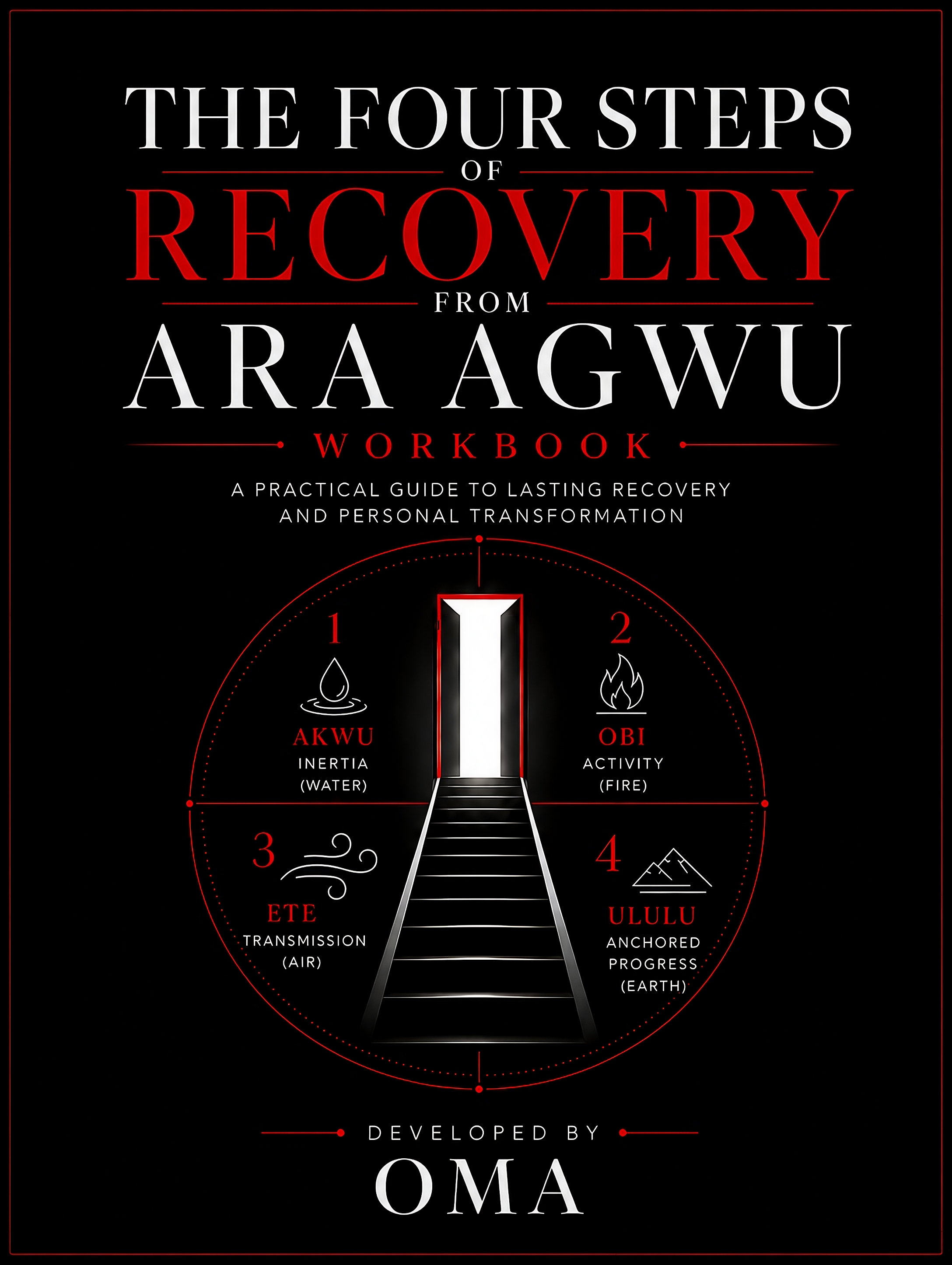
The Four Steps of Recovery From Ara Agwu (Workbook)
A practical reflection and recovery workbook designed to help seekers navigate the often complex journey of healing from Ara Agwu through a structured yet deeply personal approach.

Join Odinani Mystery School for access to Exclusive in-depth teachings on ancient Igbo wisdom and mystical sciences!