Stages of Recovery From Ara Agwu (Phase 2 of 4)
Phase One of recovery is largely about restoring movement. It is about coming out of inertia, confusion, entanglement, and fragmentation.
Phase Two begins when you are no longer simply trying to survive your internal condition. It begins when you are beginning to live again.
There is more clarity, direction, and activity.
And most importantly, there is now a growing sense that your life is moving toward something meaningful.
The four stages of this phase, which we once again derive from Afa Akpukpala framework, are:
OBI → AKA → OBALA → ORA
These stages describe a movement from purposeful activity into conscious journeying, from deeper revelation through contraction, and finally into a greater state of enlightenment and inner freedom.
The guiding element of this phase is Cosmic Light. In simpler terms: Fire.
Where Water guided the first phase by teaching movement, flow, and adaptation, Fire guides this phase by teaching illumination, conviction, transformation, and freedom.
The central instruction of Phase Two is: Do not return willingly to what you have already outgrown.
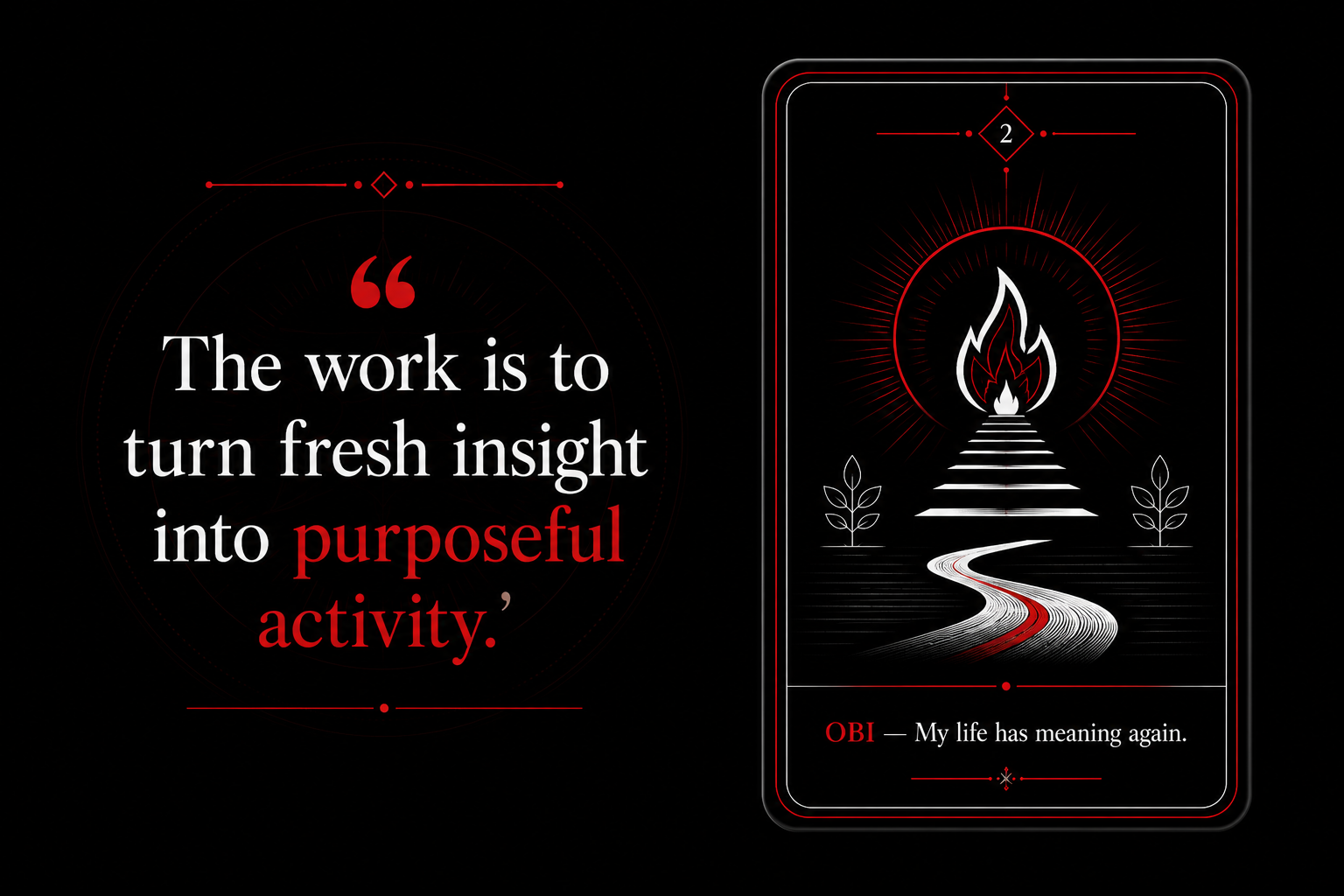
1. OBI — Activity
Life begins to move with meaning again.
Obi marks the beginning of a very important shift. At this stage, one has successfully crossed beyond the instability of Phase One.
The mind is no longer constantly trapped in survival. The confusion has reduced.
The internal coldness has begun to disappear and life starts filling again with meaningful activity.
This activity is different from being busy for the sake of being busy. A person can be extremely busy while still being completely lost.
Obi is purposeful movement.
You begin doing things because they now make sense to you.
You start making decisions from fresh insight rather than fear.
Your actions begin reflecting new convictions.
You may feel inspired to build something, learn something, change your environment, reorganize your priorities, improve your health, reconnect with meaningful relationships, or pursue work that feels more aligned with who you are becoming.
Life begins to feel active again because the internal world has begun generating direction.
This can be deeply energizing. After a long period of confusion or stagnation, even ordinary activity can feel sacred.
Cleaning your space, working, walking outside, or even creating, may all feel different. At this point, you are no longer performing actions mechanically. Instead, you are beginning to feel yourself inside your own life again.
That is important. Obi teaches that activity becomes restorative when it emerges from alignment. But there is also something one must be careful about here.
After long periods of stagnation, there can be a temptation to do too much too quickly. The excitement of feeling alive again can make a person overcommit.
They may attempt to rebuild every area of life at once, or mistake new energy for infinite energy. Do not do this. Purposeful activity should restore you, not exhaust you.
Fire gives warmth and light. But unmanaged fire can also consume.
Move with conviction, but also with wisdom.
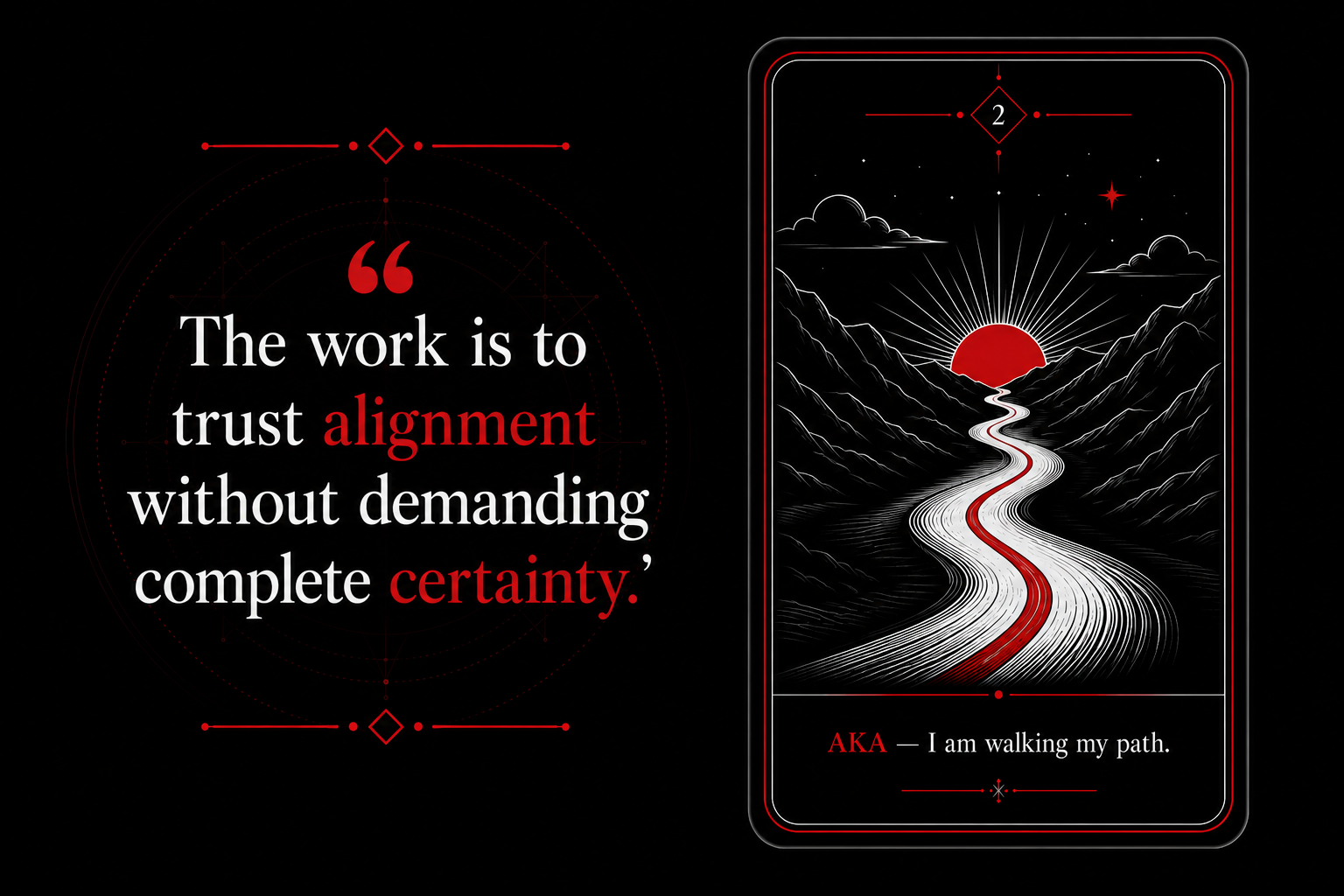
2. AKA — Journeying
You now recognize that you are on a path.
Aka represents journeying. At this stage, the new direction discovered in Obi begins becoming more concrete. You are actively walking it.
Your life may begin reorganizing itself around new values, new priorities, new relationships, new responsibilities, or a deeper understanding of purpose.
You begin trusting yourself again by developing confidence in your own ability to navigate.
Your intuitive insight becomes stronger because you have had enough experiences to begin recognizing the difference between fear, impulse, confusion, and genuine inner direction.
You start understanding your own signals. You begin noticing what feels aligned. You recognize more quickly what drains you.
You notice which environments allow you to expand and which ones cause you to contract. You begin making choices with greater internal coherence.
This is what makes Aka a journey rather than simple movement.
You are no longer wandering. You may not know the final destination, but you have begun recognizing the road.
And this is where one must learn an important principle —> Alignment is not the same thing as certainty.
You can be aligned without knowing every outcome. You can be on the right path without knowing exactly where it will lead.
Many people sabotage themselves because they believe they must understand the entire journey before they are allowed to trust the next step. But life rarely reveals itself that way.
Sometimes you are given enough light only to see what is directly in front of you. That is enough. Walk the path. Then more will become visible.
Aka teaches you to move forward with the light you currently possess.
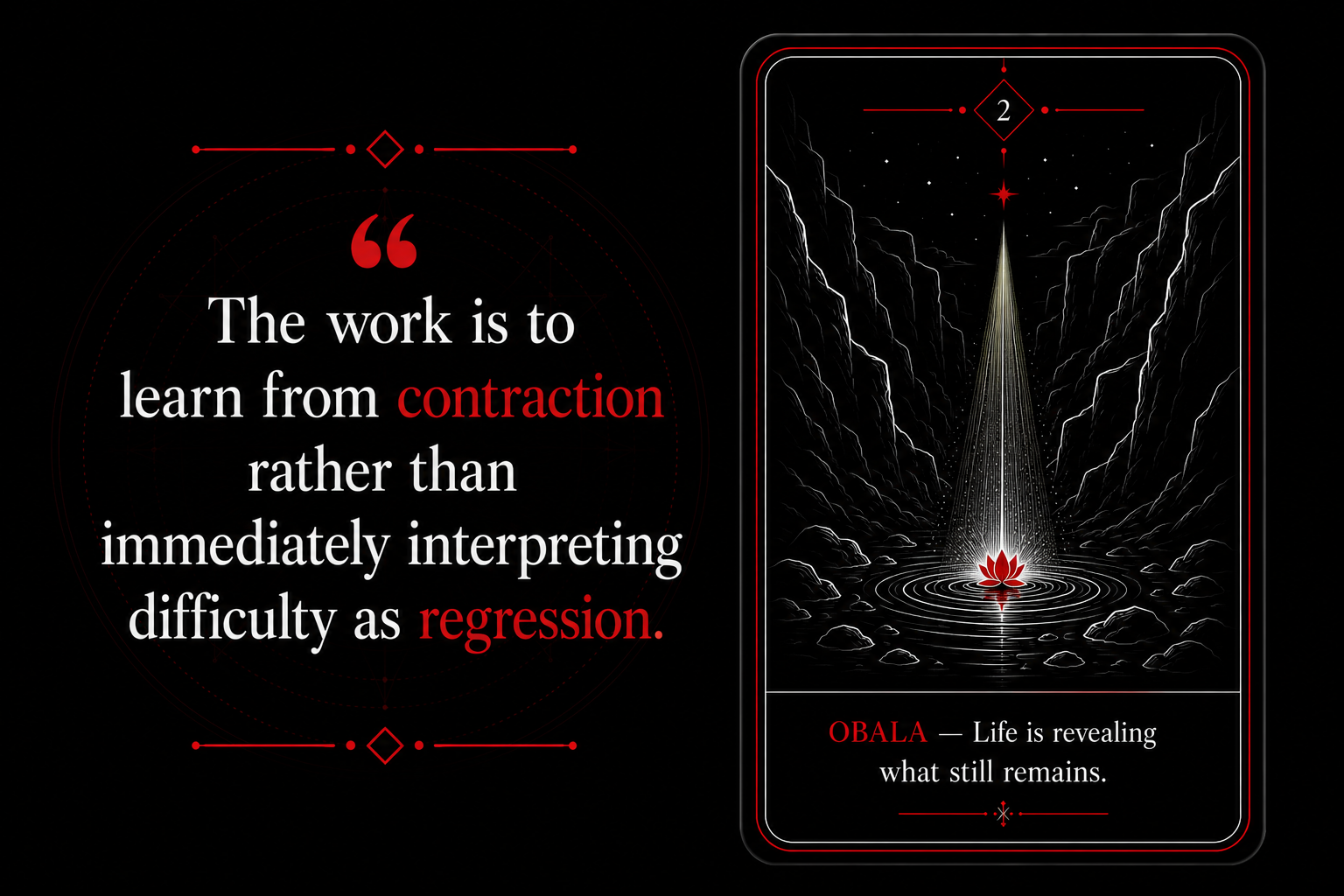
3. OBALA — Contraction
Growth continues, but now through pressure, limitation, and deeper revelation.
Obala is a very important stage because many people misunderstand it.
After experiencing greater activity, clarity, and alignment, one may assume that recovery should now become completely smooth. It does not.
There are still challenges, difficulties, even moments of uncertainty. But the nature of these challenges has changed.
In earlier stages, difficulty may have felt chaotic and disorienting. Here, difficulty mostly becomes instructional.
Obala is contraction. Something tightens. Life may suddenly restrict an option. A relationship may change. A plan may fail. A door may close. A sense of responsibility may increase.
Something you believed was settled may return for deeper examination. At first, this can feel like regression. But not every contraction is regression.
Sometimes contraction is what allows deeper truth to emerge. Think about fire. Heat changes matter. It concentrates, exposes weakness, removes moisture.
It separates what can endure from what cannot.
In the same way, Obala introduces pressures that reveal more about who you are becoming.
A challenge may expose a fear you thought you had already overcome.
A disagreement may reveal an unresolved attachment.
A disappointment may show you that you were still relying too heavily on external validation.
A delay may expose your impatience.
An unexpected loss may reveal what you were unconsciously clinging to.
These experiences are not always signs that something has gone wrong. Sometimes they are signs that another layer is being revealed.
This is why the process of revelation continues in Phase Two, but on another dimension. You are now discovering what still remains.
Obala therefore asks:
What is this challenge revealing?
What is being compressed out of me?
What am I still carrying that cannot come with me?
What belief is being tested?
What attachment is being exposed?
What truth have I not yet fully accepted?
The danger at this stage is taking every contraction personally. Do not assume every difficulty means failure. Do not assume every closed door means you have lost your way.
Sometimes life contracts around you because something inside you is being refined.
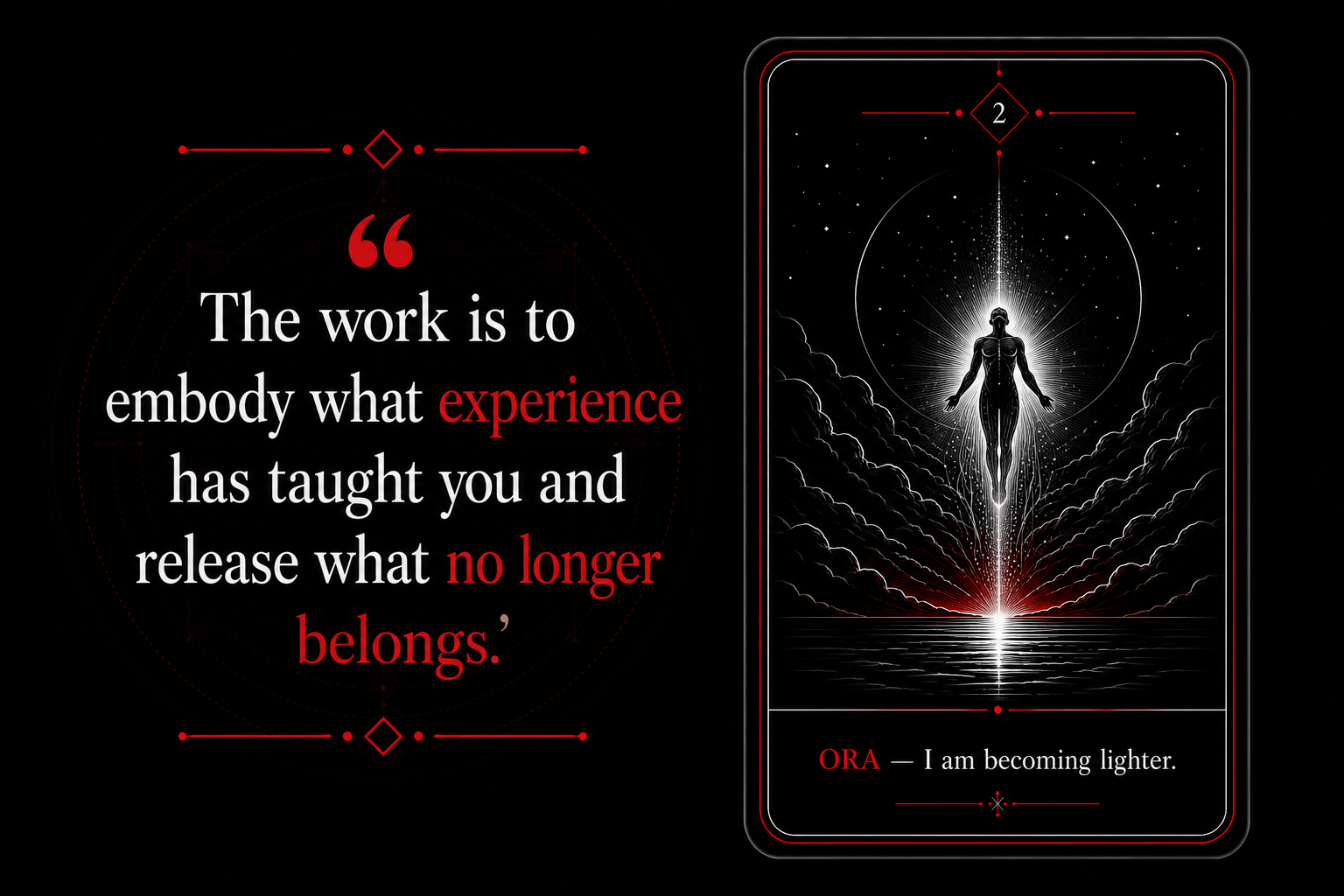
4. ORA — Enlightenment
The person emerges lighter.
Ora represents enlightenment. At this stage, one has accumulated enough experience, observation, struggle, adjustment, and self-confrontation that a deeper kind of understanding begins to settle.
You are now becoming changed by all the insight you have been collecting. There is a difference between knowing something intellectually and knowing it because life has taught it to you directly.
Ora is lived understanding derived from lived experience. You begin seeing your past differently.
Things that once confused you begin making sense. Experiences that once felt meaningless may reveal their place within a larger pattern.
You become more aware of your own nature. You understand more clearly what belongs to you and what does not.
You become less desperate to explain yourself. Less desperate to be understood, to force situations, or to return to old identities.
There is a lightness that begins emerging because you are carrying less unnecessary weight. This is one of the most beautiful aspects of Ora.
Freedom begins to feel natural.
You stop trying to drag dead things into your future.
You begin releasing arguments you no longer need to win.
You let go of environments you have outgrown.
You stop chasing approval from people incapable of understanding your path.
You become more selective about what deserves your energy.
Life becomes lighter because your relationship with life has changed. There is more light. More meaning and inner space. But Ora is not the end of recovery. It is important to understand this.
Enlightenment at this stage does not mean perfection. You are still on the journey and can still make mistakes. You can still experience pain and be tested.
But you are no longer the same person experiencing those things.
Your consciousness has changed. And because you have changed, the same problems no longer have the same power over you.
The Guiding Element of Phase Two: COSMIC LIGHT
The guiding element of this phase is Cosmic Light. In simpler language: Fire.
Fire represents illumination. It reveals what darkness hides. It warms what has become cold. It transforms whatever comes into sustained contact with it.
It can destroy, purify, protect, and create. This is the energy of Phase Two.
You are learning how to live from an internal flame. Your newly discovered convictions begin generating direction.
Your clarity becomes a source of heat. Your purpose creates movement. Your experiences create illumination. But Fire carries an important warning.
Do not carry unnecessary baggage into a place that requires lightness.
This phase demands release. You cannot fully embrace new freedom while continuously dragging old chains behind you.
Some things must be left behind.
Old guilt, shame, identities, and relationships that exist only through obligation.
Old beliefs that no longer correspond with reality.
Old fears.
Old versions of yourself.
Old battles.
Not everything must come with you simply because it has been part of your story. This is where many people slow their own recovery.
They want a new life while insisting on carrying everything from the old one. But transformation requires selection. Fire teaches this clearly.
Some things survive fire, while others things simply do not.
Do Not Confuse Familiarity With Belonging
One of the greatest dangers in Phase Two is being pulled backward by what feels familiar.
Familiarity can be deceptive.
A situation may feel comfortable simply because you already understand its pain.
A relationship may feel safe because its dysfunction is predictable.
An old identity may feel easier because it requires less courage.
A former environment may feel like home simply because you know how to survive there.
But familiarity is not always alignment.
As you move deeper into Phase Two, you may notice that some people, places, habits, and expectations no longer fit.
Do not immediately interpret this as arrogance or disconnection. Growth naturally creates distance from certain things.
The seed does not apologize for becoming a tree.
The problem begins when you feel guilty for changing and intentionally return yourself to conditions you have already outgrown.
That is how unnecessary baggage becomes dangerous, by convincing you to carry it.
Freedom Must Be Practiced
At this stage, freedom must become a practice.
You practice freedom every time you make a decision from clarity rather than fear. Whenever you stop explaining yourself unnecessarily. When you leave what repeatedly diminishes you. When you create boundaries.
You practice freedom when you choose responsibility over chaos. When you allow yourself to enjoy life without guilt. When you accept that not everyone will understand who you are becoming.
This is important because many people escape a condition physically while remaining mentally imprisoned by it.
Your freedom requires internal participation. You must allow yourself to become free.
Sometimes the cage is open long before the person decides to leave.
Phase Two asks you to walk out.
The Four Movements of Phase Two
The progression of this phase can be understood simply:
OBI — My life has meaning again.
The work is to turn fresh insight into purposeful activity.
AKA — I am walking my path.
The work is to trust alignment without demanding complete certainty.
OBALA — Life is revealing what still remains.
The work is to learn from contraction rather than immediately interpreting difficulty as regression.
ORA — I am becoming lighter.
The work is to embody what experience has taught you and release what no longer belongs.
Together, these four movements describe a major transformation.
Phase One teaches you how to move again. Phase Two teaches you why you are moving.
And once purpose enters movement, recovery changes.
Rest assured, you are no longer simply escaping suffering. Instead you are beginning to build a new life.
To Sum It Up
The central lesson of Phase Two is to find light, hold unto it and protect it.
There will always be things capable of pulling you backward.
Old environments.
Old relationships.
Old fears.
Old habits.
Old expectations.
Sometimes even your own nostalgia.
You must learn to recognize when something from the past is offering wisdom and when it is simply asking you to return to your old self.
Carry the wisdom. Leave the weight. Embrace the freedom you have discovered. Move with purpose. Allow challenges to refine rather than define you.
Trust the road even when only the next few steps are visible. And when life reveals another layer of yourself that must be released, do not immediately mourn it as a loss.
Sometimes becoming lighter feels like losing something. Until you realize what you lost was the weight preventing you from moving freely.
Keep the flame. Keep walking.
Jisie ike.








Recommended Resources:
Nne Agwu: The Totality Sum Form of Agwu | Odinani Mystery School
Ebo Agwu: The Particularized Form of Agwu | Odinani Mystery School
Multiple Ways We Can Understand Agwu from Afa | Odinani Mystery School
Agwu Ishi Ora (The Head of All Agwu) | Odinani Mystery School

Join Odinani Mystery School for access to Exclusive in-depth teachings on ancient Igbo wisdom and mystical sciences!